

Why Google Reputation Management Can Make or Break Your Business
Google reputation management is the process of controlling what appears when someone searches for your business — including search results, reviews, images, and AI-generated summaries.
Here is a quick overview of what it involves:
- Audit your current Google search presence (search your business name in incognito mode)
- Remove content that violates Google’s policies (personal data, fake reviews, policy-breaking pages)
- Suppress damaging-but-legal content by ranking stronger, accurate content above it
- Optimize your Google Business Profile to control your local search presence
- Monitor all search surfaces continuously so problems don’t sneak up on you
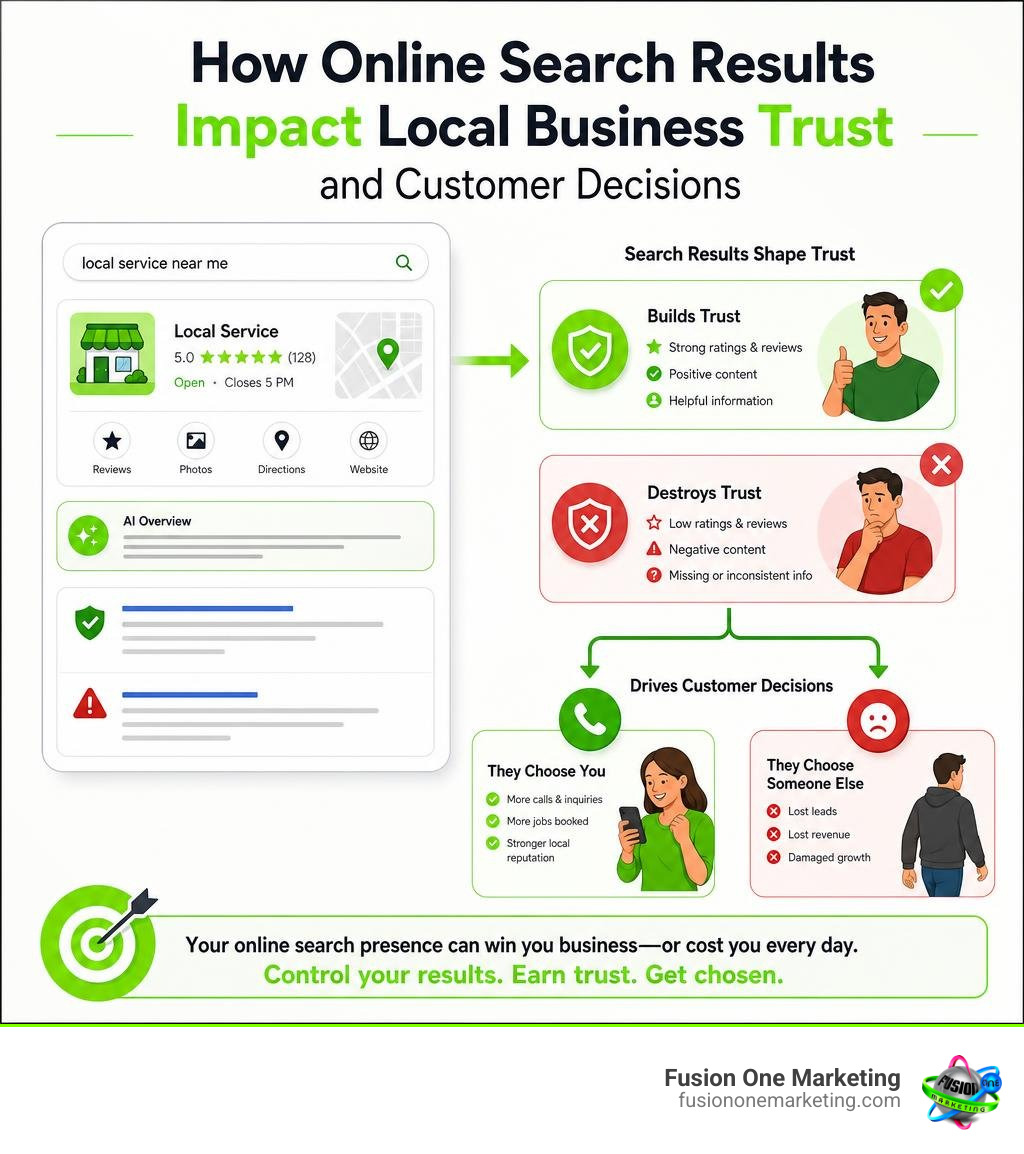
Think about this for a moment. More than 90% of online experiences start with a search engine, and Google holds over 91% of the market share. When a potential customer searches for a plumber, an HVAC technician, or a landscaper in their area, the very first thing they see shapes their opinion — before they ever call you.
And it is not just the blue links they are looking at. Google also shows your star rating, customer reviews, photos, and even an AI-generated summary of your business right at the top of the page. If any of that looks bad, most people will simply move on to your competitor.
The hard truth? 92% of clicks stay on page one. If something negative is sitting there, it is costing you real customers every single day.
This is not just a big-brand problem. For small home service businesses — the kind that live and die by local trust — your Google presence is often the single most important factor in whether a stranger picks up the phone and calls you.
I’m Rob Humm, co-owner of Fusion One Marketing, and I’ve been working in digital marketing since 2011, helping local businesses take control of their online presence — including Google reputation management for home service companies that can’t afford to let a bad search result chase away leads. In this guide, I’ll walk you through exactly what you need to know, in plain language, without the technical overwhelm.
Handy google reputation management terms:
What is Google Reputation Management and Why It Matters
When we talk about your “digital footprint,” we are talking about the trail of data your business leaves across the internet. But on Google, that footprint is compressed into a single page of search results. Whether you run an HVAC company in Birmingham, AL, a plumbing business in Huntsville, AL, or a landscaping service in Helena, AL, what people see when they search your name is your brand perception.
If a prospective client types your business name into search and sees a 2.5-star rating, a negative blog post, or an outdated court record, they will instantly form a negative opinion. They do not know that the 2.5-star rating is from two fake accounts, or that the blog post was written by a disgruntled ex-employee. To them, Google is the ultimate source of truth.
This is why Online Reputation Management is a critical pillar of local SEO. If you have spent months optimization your website to rank for “AC repair near me,” but your business listing is plagued by unresolved negative feedback, your SEO efforts are essentially driving traffic straight to your competitors. To understand the full scope of how this works, check out our guide on Reputation Management What It Is Do You Need It.
Proactive Google Reputation Management for Businesses
Most business owners only think about their online reputation when a crisis hits — like a sudden wave of spam reviews or an unfair local news article. But waiting for a crisis to react is like waiting for your basement to flood before checking your sump pump.
Proactive google reputation management is about building a defensive shield around your brand authority long before anything goes wrong. By creating a strong network of positive assets, you ensure that any future negative content has a much harder time climbing to page one.
When you understand search intent, you can build content that directly answers what your customers are looking for, securing high-quality customer acquisition and leaving no room for negative rumors to take root. If you want to get ahead of the curve, you can start taking steps today to Improve Your Online Reputation.
The Seven Surfaces of Your Google Search Footprint
Many people think Google is just a list of ten blue links. In reality, Google’s search engine results page (SERP) is a complex ecosystem made up of seven distinct “surfaces.” To manage your reputation successfully, you must address all seven of these areas:
- Organic Search Results: The traditional blue links and descriptions that rank based on relevance and authority.
- Google Business Profile & Local Pack: The map-based results that display local businesses, their locations, and star ratings.
- Google Reviews: The star ratings and written feedback left directly on your Google Business Profile.
- Knowledge Panel: The structured information box that appears on the right side of desktop search results, displaying key facts about your business.
- AI Overviews: The AI-generated summaries that synthesize search results and display them at the very top of the page.
- Autocomplete: The search suggestions that drop down as soon as someone starts typing your business name.
- Google Images: The visual search results that can display your team, your work, or unfortunately, unwanted screenshots and photos.

To help you understand how traditional search results compare to the newer AI-driven features, we’ve broken down the key differences below:
| Feature | Traditional Search Results (Blue Links) | AI Overviews (Generative Search) |
|---|---|---|
| Location on Page | Middle and lower sections of page one | The absolute top of the page, above all organic links |
| How Content is Generated | Displays direct links to crawled web pages | Synthesizes and summarizes information from multiple sources |
| Primary Focus | Domain authority, keywords, and backlinks | Entity signals, source citations, and direct answers |
| User Interaction | Users click through to read individual sites | Users read the summarized answer directly on Google |
Managing AI Overviews and Generative Search
The introduction of AI Overviews has completely changed the rules of google reputation management. Because these summaries sit at the very top of the search page, they compress your entire online reputation into a few sentences written in Google’s own words.
If there is a defamatory blog post or an outdated news article ranking in the top 20 search results, Google’s AI might pull from that source and state it as an absolute fact in the AI summary. This is why SEO Reputation Management: Protect Google & AI Search Results is so important.
To fix an inaccurate AI Overview, you cannot simply click an “edit” button. Instead, you have to target the underlying web pages that the AI uses as sources. By removing or suppressing those negative source pages and strengthening your structured entity signals (like Schema markup on your website), you can guide the AI to summarize accurate, positive facts. For a deeper look at this process, check out this guide on Google AI Overview Reputation Management | Fix the Answer.
Removal vs. Suppression: How to Clean Up Search Results
When dealing with negative search results, you have two primary weapons: removal and suppression.
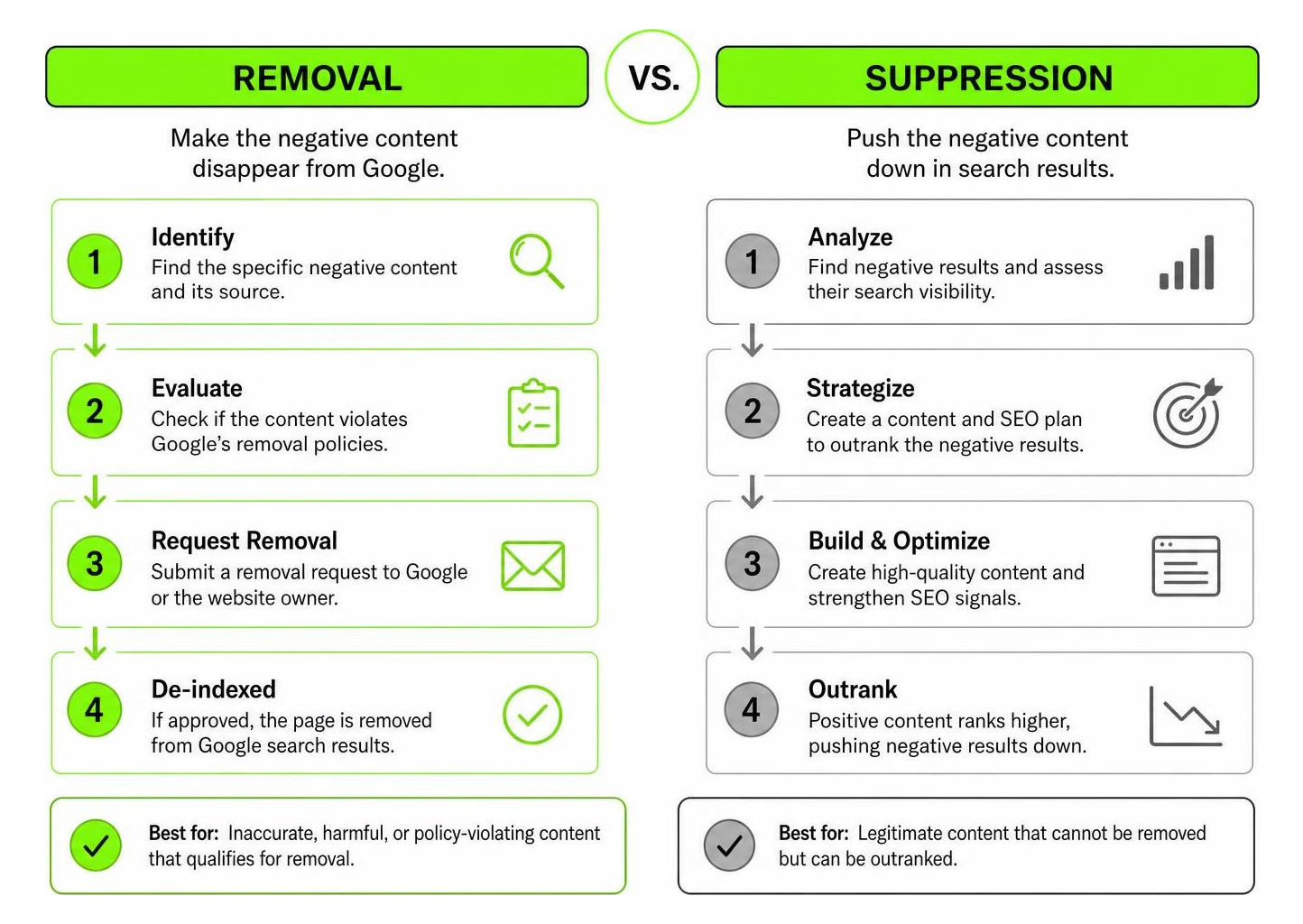
Understanding when to use each strategy is key to cleaning up your search footprint without wasting time and resources. If you want to manage your personal details directly, you can start with the official Manage your online reputation – Google Account Help page.
Removing Unwanted Content from Google
Removal (or de-indexing) is the gold standard of reputation repair because it makes the negative link disappear from Google search results entirely. However, Google will only remove content if it violates their strict policies.
You can successfully request the removal of:
- Personally Identifiable Information (PII) like your personal phone number, home address, or financial records.
- Doxxing content or non-consensual imagery.
- Copyrighted material via DMCA takedown notices.
- Defamatory content that violates local laws (often requiring a court order).
If the content is hosted on a third-party site and does not violate Google’s policies, you must contact the website owner directly to request removal before asking Google to clear it from their index.
Suppressing Negative Content with SEO
If a negative search result is damaging but completely legal (such as an unflattering news article, a bad forum thread, or an honest negative review), Google will not remove it. In this case, your only option is suppression.
Suppression uses search engine optimization to build a wall of high-authority, positive assets that push the negative link down to page two or three. Since 92% of search clicks stay on page one, pushing a negative link to page two effectively makes it invisible to the vast majority of searchers.
To suppress negative content, you must diversify your content and build links to positive assets, such as:
- Your official website and localized landing pages.
- Highly optimized social media profiles (LinkedIn, YouTube, Facebook).
- Press releases on high-authority news networks.
- Branded profiles on local business directories.
For a comprehensive playbook on how to execute this strategy, read Google Reputation Manager 2025: Clean Up Search Results & Protect Your Brand.
Mastering Google Business Profile and Customer Reviews
For local home service businesses in Alabama, your Google Business Profile (GBP) is the heart of your online reputation. It is what powers your presence in the local pack (the map listings at the top of local searches).
Statistics show that 98% of consumers read online reviews for local businesses, and more than 60% of customers rely on a company’s Google Business Profile to learn more about them. If your GBP has a poor rating, you are losing leads before they even visit your website. To keep your profile in top shape, check out the official Manage customer reviews – Google Business Profile Help page, and read our deep dive on Why Your Google Business Profile Matters More Ever.
How to Handle Negative Reviews and Flag Violations
Every business owner dreads getting a 1-star review, but how you handle it can actually turn it into a positive marketing opportunity. First, you must determine if the review is legitimate or if it violates Google’s terms of service (such as fake reviews, spam, or harassment).
If a review is fake or violates policy, you can flag it within your GBP dashboard for Google to review. While you wait for Google to make a decision, or if the review is from a genuinely unhappy customer, you must respond professionally.
Here is our quick guide to responding to negative reviews:
- Keep your cool: Never argue, get defensive, or attack the reviewer publicly.
- Acknowledge and validate: Apologize for their poor experience and show that you care.
- Move it offline: Provide a direct phone number or email address and ask them to contact you so you can make things right.
For more strategic tips on handling these situations, read our guides on Negative Reviews and How To Turn A Negative Review Into A Positive Experience. And remember, while you can’t easily delete a Google review, learning How To Delete A Review On Yelp can help you manage your reputation on other platforms. Understanding Why Responding To Your Customers Online Is Crucial is the first step to mastering customer relations.
Strategies for Requesting and Scaling Positive Reviews
The absolute best defense against a negative review is a steady stream of positive ones. You should make review generation a seamless part of your daily operations.
Here are the most effective ways to scale your reviews:
- Use direct review links: Send a direct link to your GBP review page via text or email immediately after completing a job.
- Incorporate QR codes: Print QR codes on your business cards, invoices, and truck magnets so customers can scan and review you on the spot.
- Train your team: Encourage your technicians in Birmingham or Huntsville to ask happy customers for feedback before leaving their homes.
To build a reliable system for gathering feedback, check out our Top Tips For Requesting Google Reviews From Your Customers. You can also use The No Cost Guide To Tracking Down Google Reviews By Name to monitor your feedback, and learn about The Importance Of Having A Review System to keep your business growing. For industry-specific ideas, read How To Get More Online Reviews For Your Pest Control Business or find out How To Leverage Customer Reviews And Testimonials To Boost Your Online Reputation.
Frequently Asked Questions About Search Reputation
How long does it take to fix search results?
The timeline for google reputation management depends heavily on whether you are removing or suppressing content.
- Removals: Qualifying policy-violating content can often be removed within 2 to 12 weeks, depending on how quickly Google processes the request.
- Suppression: Pushing down a high-authority negative link using SEO suppression typically takes 3 to 6 months of consistent content creation, link building, and optimization. This timeline is dictated by Google’s crawl budget and how frequently their algorithm updates the search index.
Can I delete a Google review myself?
No, you cannot directly delete a review left by a customer on your Google Business Profile. You can only flag the review if it violates Google’s Prohibited and Restricted Content policies. If Google finds that the review is indeed fake, off-topic, or spam, they will remove it.
If you notice that some of your legitimate positive reviews are missing, read Google Business Profile Reviews Not Showing Up Heres Why to troubleshoot the issue.
When to Hire a Professional Google Reputation Management Service
While you can handle basic review monitoring and profile optimization yourself, there are times when professional help is absolutely necessary. You should consider hiring a professional service if:
- You are facing a sudden viral PR crisis that threatens to destroy your business.
- Highly damaging, false search results are ranking on page one and refuse to budge.
- Your Google Business Profile has been suspended, hijacked, or severely penalized.
- You do not have the internal resources or technical SEO expertise to run a long-term suppression campaign.
When looking for a partner, avoid any agency that guarantees “instant removals” or uses black-hat SEO tactics (like fake reviews or link schemes), as these will ultimately result in severe penalties from Google. Instead, look for a reputable agency that offers transparent pricing, realistic timelines, and a proven track record. For more details on what professional services look like, check out Google Reputation Management | Fix Your Search Results.
Conclusion
Your online reputation is your most valuable digital asset. In our local Alabama service areas — from Birmingham to Huntsville and Helena — a positive Google presence is what separates the thriving businesses from those that struggle to keep their phones ringing.
At Fusion One Marketing, we build brand protection directly into our all-in-one Digital Domination program. We don’t just optimize your website; we manage your entire search footprint, protect your brand from negative results, and help you scale your positive reviews so you can dominate your local market with confidence.
Ready to take control of what people see when they search for your business? Read our ultimate guide on How to Get More Company Reviews and Grow Your Business and let’s start building a Google footprint you can be proud of!