

Foundations: Strategy vs Tactics and the Reputation-First Principle
To build a digital marketing strategy, start by auditing your current assets, defining buyer personas, setting SMART goals, selecting a channel mix across search, social, and email, and optimizing conversion funnels. This roadmap aligns your messaging, channels, and resources directly with measurable revenue goals.
Too many businesses confuse frantic activity with actual progress. Posting three times a week on Instagram or tweaking a headline on your homepage are not strategies; they are tactics. A true digital marketing strategy is your overarching master plan—the architectural blueprint that aligns your messaging, channels, and resources directly with measurable revenue goals.
Understanding how these elements fit together prevents you from burning budget on disjointed efforts:
| Dimension | Digital Marketing Strategy | Marketing Campaign | Marketing Tactic |
|---|---|---|---|
| Primary Purpose | Long-term roadmap connecting business goals to digital channels | Focused, time-bound initiative aimed at a single objective | Specific, hands-on action or tool used to execute |
| Time Horizon | 1 to 3 years (reviewed quarterly) | 30 to 90 days | Daily or weekly execution |
| Core Metric | Customer Lifetime Value (CLV), Customer Acquisition Cost (CAC), overall ROI | Cost Per Lead (CPL), campaign conversion rates, event sign-ups | Click-through rates, social shares, page impressions |
| Example | Dominating local service searches across Alabama | Fall maintenance discount drive for local homeowners | Publishing an on-page SEO blog targeting furnace repairs |
Before spending a dollar on ad clicks, you must establish authentic trust. By building long-term brand authority, you ensure prospective buyers see an established leader rather than a fly-by-night operation.
Modern buyers are thorough researchers. Research indicates that 85% of consumers conduct online research before buying, with 74% relying heavily on websites and 38% checking social platforms. If prospects find broken profiles, outdated content, or poor ratings, they bounce immediately. By mastering online review systems, you establish the social proof required to turn incoming web traffic into booked appointments.
The Cost of Skipping Trust Before Scaling Ads
Dumping ad dollars into a business with zero online reputation is like pouring water into a leaky bucket. Paid traffic simply magnifies what is already there: if your reputation is non-existent or negative, scaling ads merely accelerates how fast you waste cash.
Paid online channels account for 69% of total digital spend, representing roughly 30.6% of overall marketing budgets. When conversion friction is high due to missing reviews, confusing landing pages, or poor messaging, your acquisition costs skyrocket. If you are struggling with improving qualified lead volume, look at your foundational trust signals before blaming the ad platform. Real customer proof must always precede paid amplification.
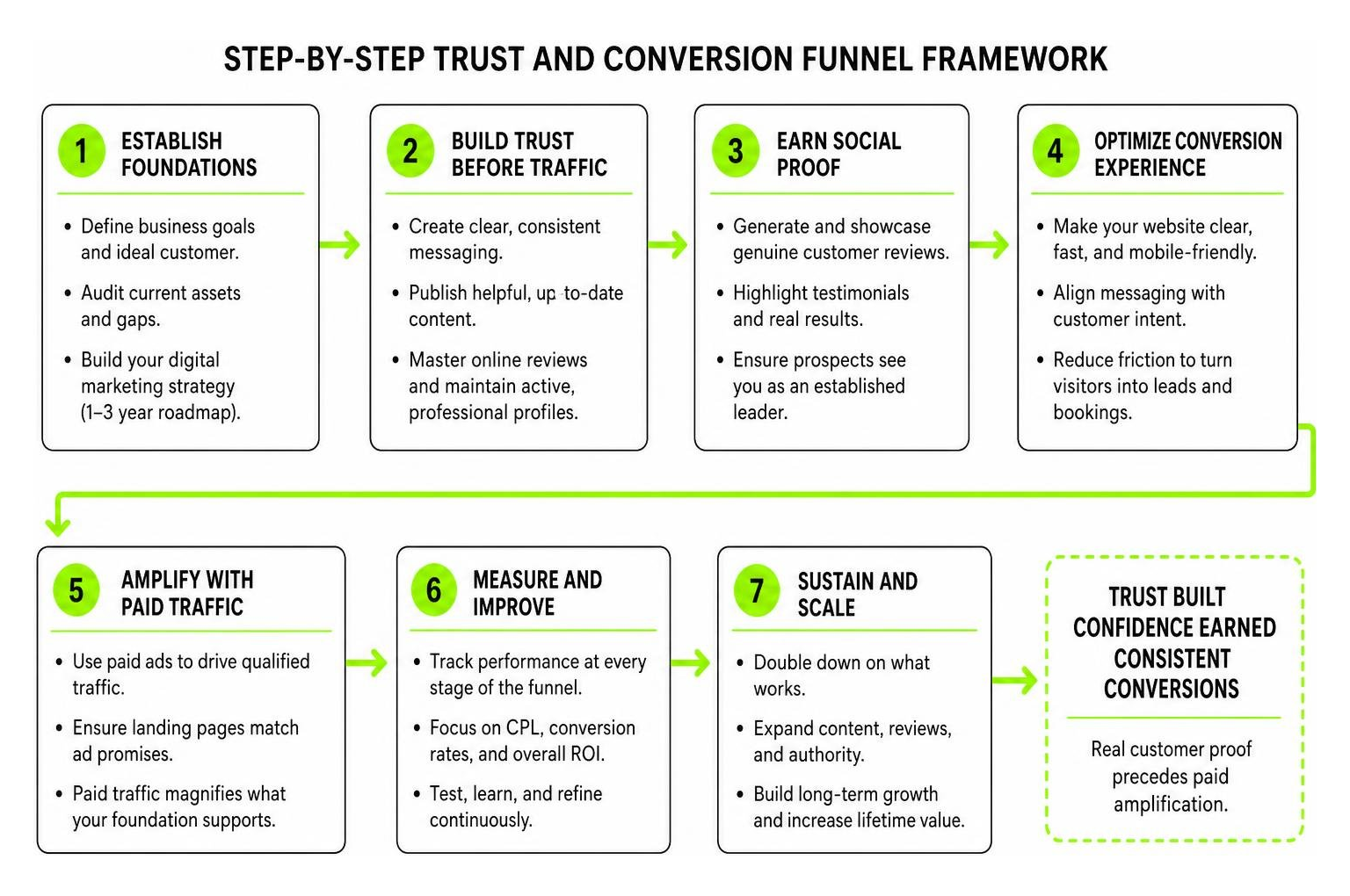
Step-by-Step Blueprint on How to Build a Digital Marketing Strategy
Building an effective roadmap requires stepping back to evaluate your current assets, market positioning, and growth capacity. It is not about guessing which new platform to test; it is about building a repeatable, data-backed engine.
A successful rollout starts with performing a digital marketing audit to benchmark what you currently own: your website speed, backlink health, organic rankings, tracking pixels, and customer data. Analyzing what top competitors are executing helps you identify market gaps and refine your value proposition. As highlighted in enterprise digital strategy planning insights, companies that document their strategy and audit assets systematically are far better equipped to adapt to market shifts and maximize ROI.
How to Build a Digital Marketing Strategy Foundation with Audience Research and SMART Goals
Every successful marketing plan rests on two pillars: precise customer understanding and crystal-clear objectives.
Start by identifying your ideal target audience. Conduct 8 to 15 real customer interviews or review recent service tickets to uncover their true motivations, objections, and search behavior. Translate these findings into detailed profiles by developing detailed buyer personas. Companies that utilize structured buyer personas can increase marketing-generated revenue by up to 171%.
Once your audience is mapped out, establish SMART (Specific, Measurable, Achievable, Relevant, Time-bound) goals linked directly to your balance sheet:
- Specific: Instead of saying “get more leads,” specify “increase qualified residential HVAC installation inquiries.”
- Measurable: Set concrete benchmarks, such as generating 35 vetted form submissions per month.
- Achievable: Base targets on realistic conversion rates and team bandwidth.
- Relevant: Ensure the goal ties directly to bottom-line revenue and sustainable customer acquisition costs.
- Time-Bound: Establish a clear deadline, like achieving the target within the next 90 days.
How to Build a Digital Marketing Strategy Channel Mix Across Search, Social, and Email
You do not need to be active on 10 different platforms from day one. Instead, simplify your distribution using the Search, Email, and Social (SES) framework:
- Search (Discovery): Organic search drives 53% of all trackable web traffic. Mastering search engine optimization basics gives you sustainable, high-intent visibility when buyers actively need your services. When paired with targeted bids, maximizing returns from pay-per-click advertising provides immediate search visibility for competitive, high-margin service terms.
- Email (Owned Asset & Nurturing): Email delivers an unmatched return of roughly $36 for every $1 spent. It is the one distribution list you own outright, insulated from platform algorithm swings. Focus on nurturing prospects with email workflows that provide upfront value, seasonal tips, and clear booking prompts.
- Social (Relationship Building): With over 5.7 billion active social media users across the globe, social channels serve as your community touchpoint. Use short videos, customer stories, and project walkthroughs to build connection rather than running a constant sales pitch.
Maximize production bandwidth by creating SEO-friendly content that ranks and systematically repurposing each primary piece into social snippets, video scripts, and newsletter segments.
Building High-Converting Funnels, Retargeting, and Conversion Optimization
Generating web traffic is only half the battle. If your site does not guide users toward taking action, those clicks represent wasted capital. Only about 2% of first-time website visitors convert immediately. The remaining 98% require deliberate nurturing.

A comprehensive roadmap addresses every layer by understanding the digital marketing funnel stages:
- Top of Funnel (Awareness): Educational guides, localized search queries, and helpful videos that answer early-stage customer questions.
- Middle of Funnel (Consideration): Case studies, transparent pricing explanations, customer reviews, and detailed service comparisons.
- Bottom of Funnel (Decision): Direct consultation offers, streamlined booking forms, and strong guarantees.
To capture demand efficiently, follow conversion optimization best practices across your digital properties. When driving traffic from paid ads, avoid generic homepages by designing high-converting landing pages featuring dedicated headlines, clear trust badges, zero menu distractions, and fast load times.
Implement tracking pixels to segment non-converting visitors based on behavior. By serving tailored retargeting ads to users who viewed specific service pages, you re-engage high-intent prospects and recover lost conversions. Strategic retargeting remains one of the highest-yield tactics available, as explored in top frameworks for long-term digital growth.
Integrating AI Acceleration Without Sacrificing Content Quality
Artificial intelligence has permanently altered the digital landscape. Today, about 18% of Google searches trigger an AI summary, and studies show traditional organic click-through rates fall from 15% to 8% when an AI overview appears. Furthermore, 85% of marketers report actively reshaping their SEO strategies for AI-driven engines.
However, 48% of marketers still struggle to adapt their workflows effectively. When evaluating AI tools for business marketing, AI should serve as an accelerator, not a generic autopilot. Search engines and consumers value authentic subject-matter expertise, real project photos, verified data, and direct perspectives.
Apply practical AI marketing techniques and prompts to speed up keyword cluster brainstorming, draft ad variants, summarize transcripts, or clean up reporting data. Keep your brand voice, localized references, and final editorial quality firmly under human control.
Measuring Performance, Tracking ROI, and Avoiding Common Pitfalls
If you cannot measure your pipeline, you cannot manage it. Many businesses become paralyzed by vanity metrics like total impressions or post likes that never move the revenue needle.
High-maturity organizations measure impact by tracking marketing dollars and ROI using clear key performance indicators:
- Customer Acquisition Cost (CAC): Total sales and marketing spend divided by total new customers acquired.
- Return on Ad Spend (ROAS): Direct revenue generated for every dollar spent on paid platforms.
- Customer Lifetime Value (CLV): The total revenue a customer generates throughout their relationship with your brand.
- Lead-to-Close Rate: The percentage of incoming digital leads that convert into paying jobs.
Protect your budget by avoiding common digital marketing mistakes, such as chasing every new trend, launching campaigns without tracking scripts, or ignoring mobile responsiveness.
Establish 90-day iteration loops to evaluate performance data, double down on winning channels, and reallocate underperforming spend. If campaigns stall, learn the key indicators by spotting signs that a marketing strategy is underperforming before costs escalate.
Frequently Asked Questions About Digital Marketing Strategy
How long does it take to see measurable results from a digital marketing strategy?
Paid search and retargeting ads can generate inbound leads within days of launch. Organic search engine optimization, content marketing, and reputation building typically require 3 to 6 months to establish consistent domain authority and search visibility. We recommend evaluating overall performance through structured 90-day review cycles.
How much budget should a growing business allocate to digital marketing?
Most established small-to-midsize businesses allocate between 7% and 12% of total gross revenue to marketing, with high-growth companies investing up to 15%. Paid channels typically account for roughly 30% of that marketing spend, balanced with investments in website optimization, content creation, and automated nurture systems.
What is the biggest mistake businesses make when creating their digital marketing roadmap?
The most common pitfall is spreading resources across too many channels simultaneously without first establishing trust or conversion tracking. Businesses often launch aggressive paid ads before optimizing their local presence, website conversion path, or customer reviews, resulting in low conversion rates and wasted ad spend.
Conclusion
A profitable digital marketing strategy is never a one-time project. It is a living, measurable engine built on deep audience research, authentic trust, streamlined conversion paths, and continuous iteration.
At Fusion One Marketing, our all-in-one Digital Domination program helps home-service providers and growing businesses across Birmingham, Huntsville, and Helena, AL establish dominance in local search, paid media, and customer acquisition. Ready to upgrade your paid ad performance alongside your organic roadmap? Follow our step-by-step blueprint to build high-converting ads to turn online clicks into lifelong clients.