

Get Landscaper Marketing Help That Leads to Booked Jobs
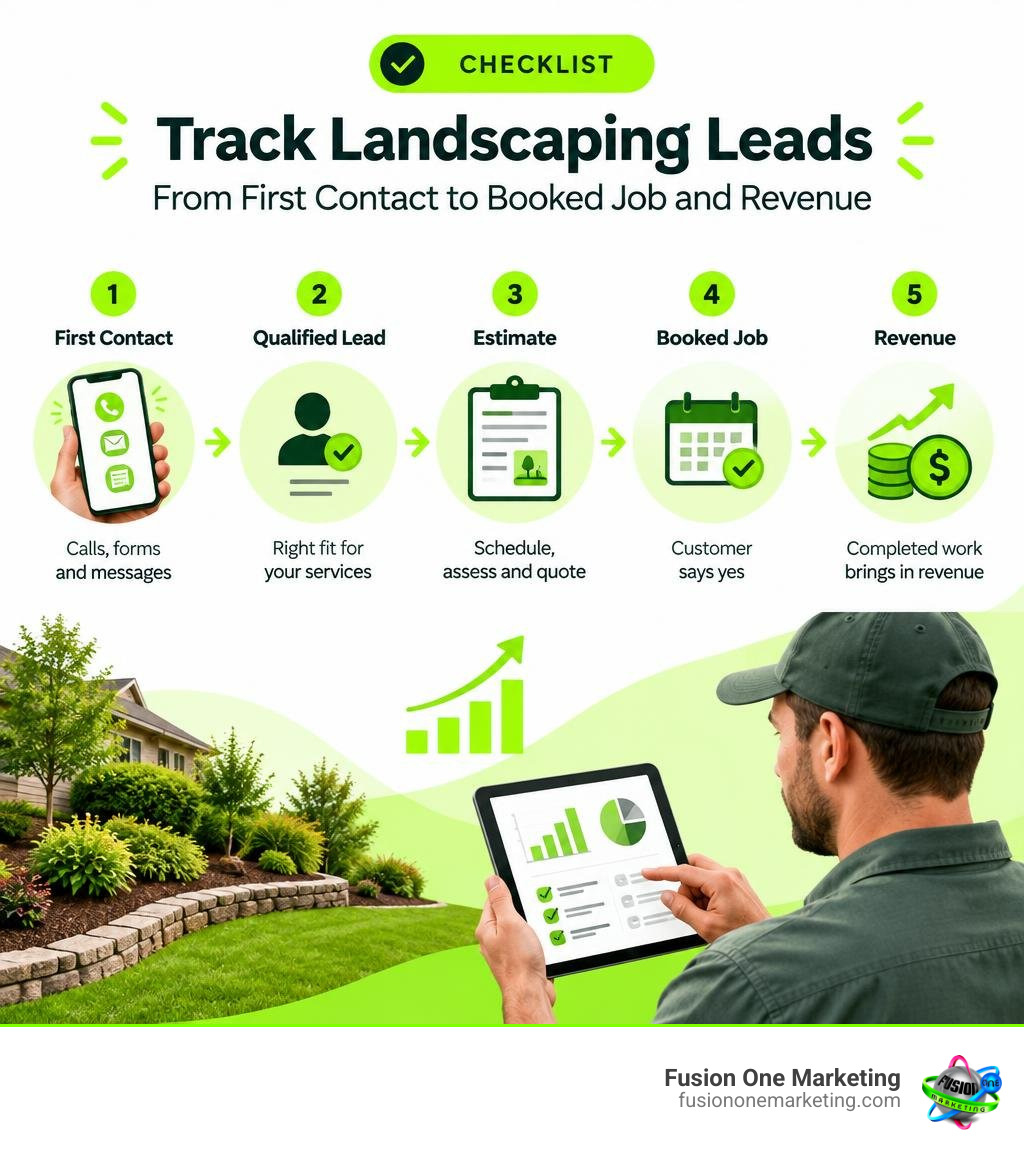
Good landscaper marketing help starts with one question: Which marketing efforts bring in profitable jobs? Every green industry business owner needs a reliable pipeline of high-margin lawn care, landscape design, irrigation, and hardscape contracts. To achieve this, you must track where each inbound call or contact form submission originated, whether it qualified for an on-site estimate, and whether that quote resulted in a paid service agreement. Allocating marketing resources toward channels that produce genuine revenue—rather than vanity metrics—is the key to scaling your enterprise.
When your phone rings consistently but your seasonal schedule remains uneven, the solution is rarely simply buying more ads. Instead, you need clear visibility into your conversion process, rapid estimate follow-up protocols, and an operational strategy that aligns marketing volume with field crew capacity.
I’m Rob Humm, an owner of Fusion One Marketing, and I’ve worked in digital marketing since 2011. My experience with local search optimization and paid advertising shapes the practical approach to landscaper marketing help you’ll find throughout this guide.
When to Seek Expert Landscaper Marketing Help for Predictable Revenue
Running a growing landscaping company is a complex balancing act between crew capacity, fleet maintenance, client retention, and seasonal shifts. When you want to expand your service routes and increase project density, pouring capital into unproven marketing channels without tracking actual job profitability leads to budget misallocation and wasted labor.

Most business owners do not suffer from an absence of marketing tactics; they suffer from an absence of strategic clarity. Understanding what digital marketing can do for you begins with tying every campaign dollar directly to closed service agreements rather than generic web clicks or broad impressions.
Common Signs You Need Marketing Help for Landscapers Instead of More Ad Spend
Increasing your monthly ad budget will not fix broken tracking, slow sales follow-up, or disjointed lead handling. If your cost per customer acquisition is unknown or climbing rapidly, look out for these warning signs:
- High Volume, Low Quality: Your office receives dozens of inquiries weekly, but calls consist of out-of-area homeowners, low-margin mowing requests, or price-shoppers looking for bottom-tier rates.
- Disjointed Channels: Your social media, pay-per-click ads, local SEO, and website operate in separate silos with no unified reporting hub.
- Unmeasured Conversion Rates: You know your gross advertising spend, but you cannot pinpoint the exact source behind your highest-paying hardscaping installations or recurring commercial accounts.
- Uneven Cash Flow: Spring brings an unmanageable flood of estimates that overwhelm your office, followed by sudden dry spells in mid-summer or late autumn that leave crews underutilized.
Recognizing these operational bottlenecks highlights the classic signs you need to revamp your marketing strategy so your marketing investments build sustainable, high-density service routes across your prime service zones.
The Pitfall of Vanity Metrics: Impressions vs. Actual Closed Sales
It is easy to celebrate monthly agency reports highlighting thousands of search impressions and hundreds of website clicks. However, clicks do not fuel commercial mowers, finance equipment upgrades, or cover weekly payroll.
When advertising reports focus purely on surface-level vanity metrics, cost-per-click distortions obscure serious profitability challenges:
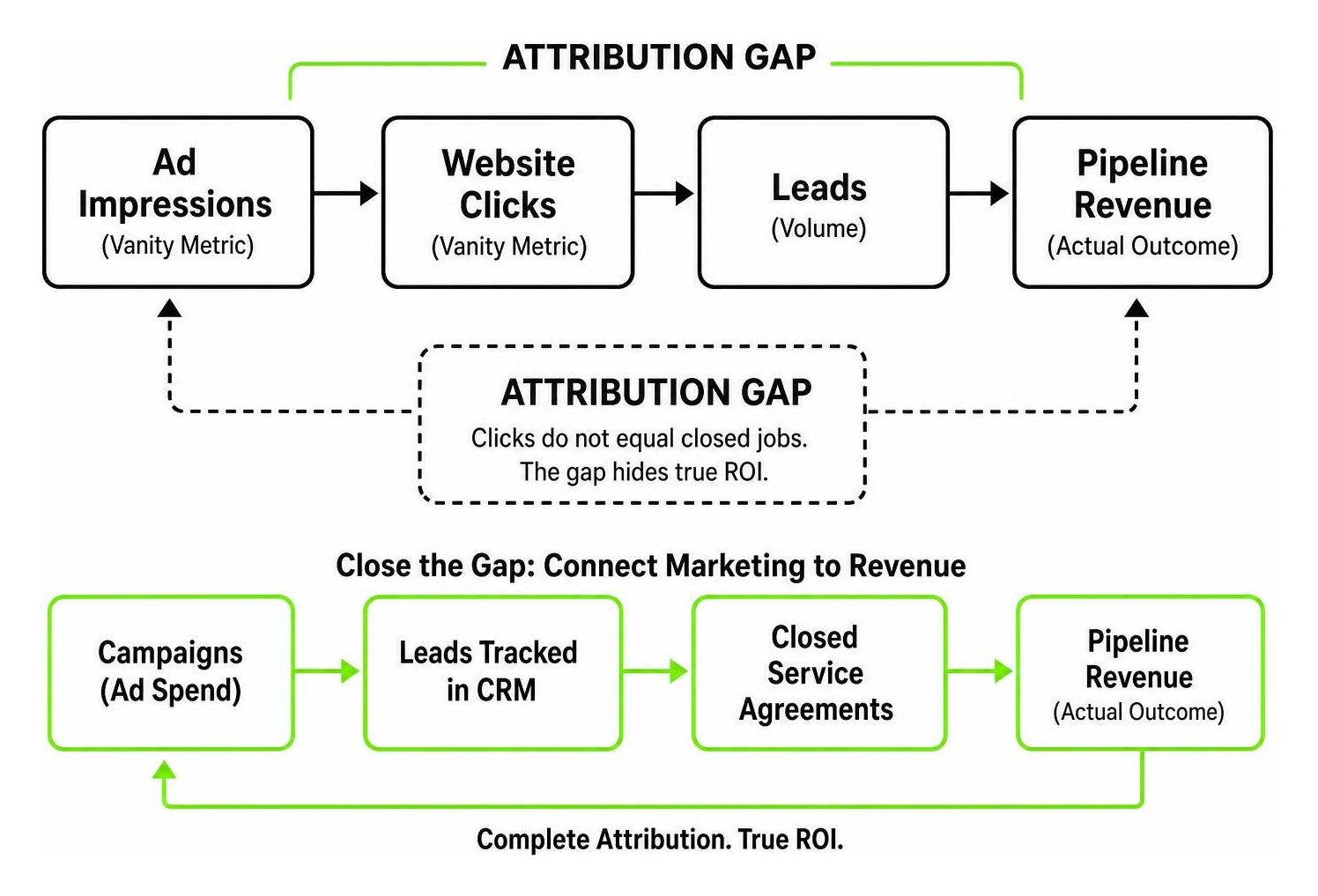
True revenue attribution requires connecting web analytics directly to your customer relationship management (CRM) software. If an ad campaign generates 40 leads at $25 per lead, but none convert into paying clients, that campaign is a net loss. Conversely, a campaign delivering only five exclusive leads at $100 per lead that yields two $15,000 hardscape installations delivers outstanding return on investment and healthy gross profit margins.
Essential Systems and Measurement Tools to Track Real Landscaping ROI
To eliminate guesswork, landscape businesses must install robust measurement infrastructure. Strategic advisory frameworks like the LeanScaper + Verily advisor models emphasize linking tactical marketing execution directly to core financial reporting, ensuring marketing spend fuels sustainable bottom-line profit.
A complete tracking ecosystem relies on three foundational systems:
- Dynamic Call Tracking: Assigns unique phone numbers to individual campaigns (Google Ads, local directories, organic search) to track which traffic sources trigger real phone conversations and quote requests.
- CRM and Sales Pipeline Integration: Records the original source of every lead throughout the estimate, proposal, follow-up, and signed-contract stages.
- Executive Revenue Dashboards: Consolidates lead volume, average job size, closing rate, and customer acquisition cost into one real-time dashboard for proactive decision-making.
Implementing Local Search and Conversion Tracking
For residential design-build contractors and commercial grounds maintenance providers across regional markets like Birmingham, AL, Huntsville, AL, and Helena, AL, map pack visibility is the lifeblood of high-intent inquiries. When property owners search for immediate lawn maintenance or custom landscape design, they choose contractors with prominent local search placement, authentic photos, and strong review profiles.
Building sustainable search visibility requires optimizing your website for local search while establishing accurate citations across regional directories. Refining your localized service pages and improving your local SEO strategy ensures that property managers find your crews first when planning commercial maintenance contracts or major property overhauls.
Tailoring Landscaper Marketing Help Across Different Growth Stages
A single-crew business requires a completely different marketing framework than an enterprise operation managing multiple regional branches. Tailoring your marketing infrastructure to your operational stage ensures your spend matches your capacity:
| Growth Stage | Revenue Range | Primary Marketing Challenge | Core Focus & Infrastructure Needed |
|---|---|---|---|
| Starter | Under $500K | Inconsistent lead flow; heavy reliance on word-of-mouth | Basic local search visibility, Google Business Profile optimization, foundational call tracking |
| Grow | $500K – $3M | Identifying high-margin services; stabilizing seasonal swings | Dedicated PPC campaigns, customer review engines, integrated CRM lead capture |
| Scaling | $3M – $10M | Increased ad spend complexity; managing multi-crew capacity | Multi-channel attribution, automated quote follow-up, tight cost-per-acquisition reporting |
| Enterprise | $10M – $30M | Multi-market brand expansion; commercial contract acquisition | Executive dashboards, territory-based routing, advanced data attribution across branch locations |
How a Structured Marketing Strategy Powers Multi-Market Growth
Expanding into new territories requires synchronizing sales funnels with operational capacity. Proven industry frameworks, such as those published by the U.S. Small Business Administration marketing and sales resources, reinforce that structured marketing must always support core business operations, fleet logistics, and workforce management.

When expanding service territories, your marketing campaigns must systematically fill routes for specific crews, preventing wasted drive time and optimizing operational efficiency.
Aligning Paid Search and Seasonal Capacity
Paid advertising offers on-demand control, allowing you to scale lead volume up or down based on your upcoming schedule. When your crews are booked weeks in advance for routine turf management, your paid campaigns can instantly pivot to target high-margin winter services, outdoor living installations, drainage solutions, or commercial grounds maintenance contracts.
Leveraging smart ways to reduce PPC spending prevents wasted clicks on low-profit services. Combining Google Local Services Ads with targeted pay-per-click strategies remains one of the best ways to secure exclusive landscaping leads without fighting competitors over shared lead platforms.
Building Lead Follow-Through Workflows to Eliminate Waste
A marketing campaign is only as effective as the speed of your sales follow-up. High-value property managers and homeowners often award bids to the contractor who provides the fastest, most professional estimate.
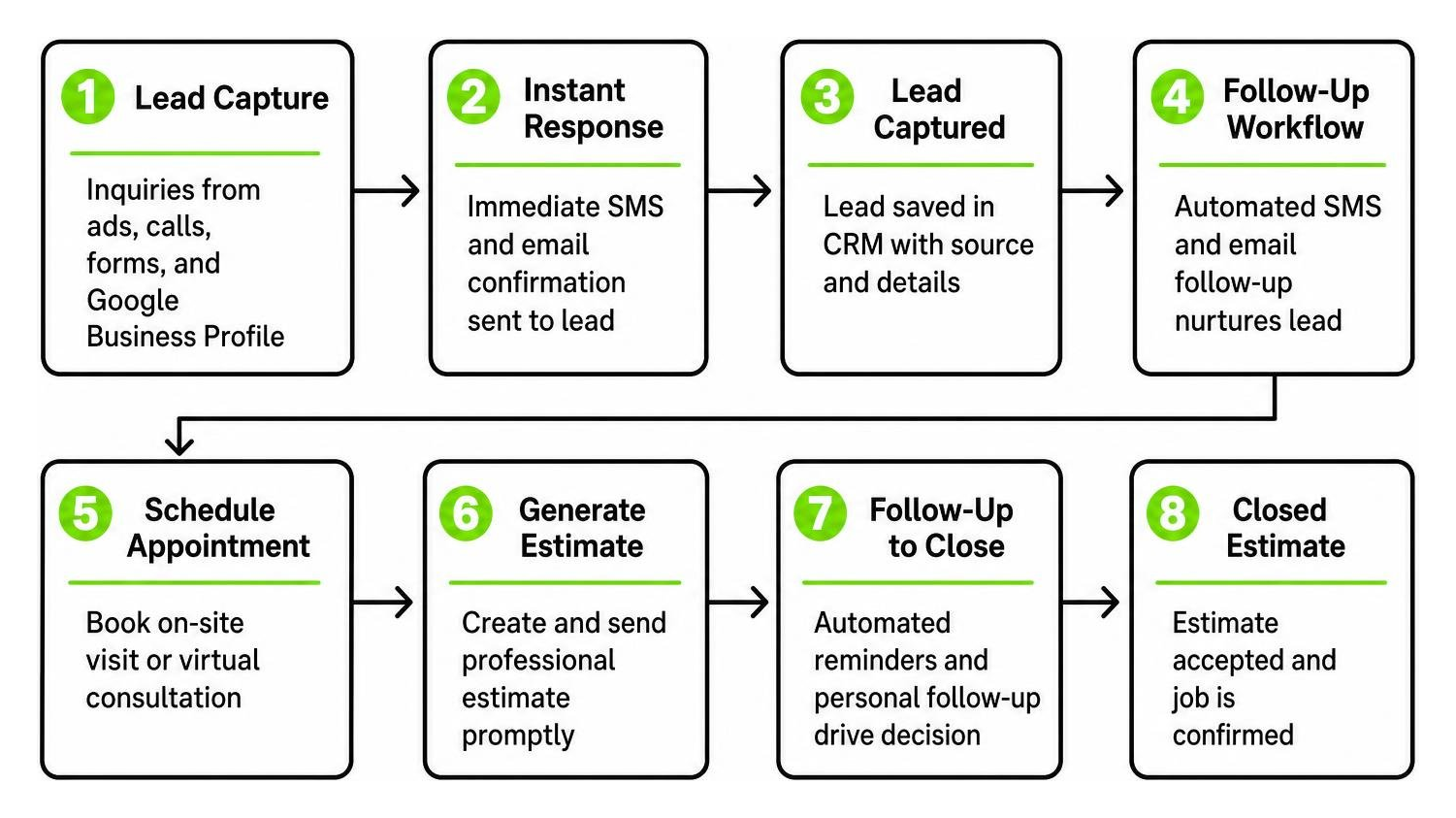
Integrating your digital ads directly with automated SMS and email workflows ensures every inquiry receives an immediate response. Tracking estimate delivery times, proposal follow-ups, and closing rates empowers your team to fix leaks in your sales pipeline before spending additional marketing dollars.
Frequently Asked Questions About Landscaper Marketing Help
What should I expect from an initial landscaping marketing assessment?
A thorough initial assessment conducts a comprehensive baseline audit of your digital presence. It reviews your current channel attribution, pinpoints your true cost per customer acquisition, evaluates your website conversion speed, and identifies leaks in your sales pipeline where potential estimates fall through the cracks. In addition, it evaluates competitor search rankings and local map visibility across your primary service territories to uncover immediate growth opportunities.
How do marketing needs change between a $1M and a $10M landscaping business?
A $1M landscape company typically focuses on generating consistent residential and commercial leads for a small handful of crews within a single metro area. A $10M operation requires multi-channel orchestration, territory-based attribution, automated sales pipeline routing, dedicated commercial outreach, and executive-level financial reporting to balance labor capacity across multiple divisions, service lines, and branch locations.
How quickly can structured attribution reduce wasted ad spend?
Structured attribution often identifies wasted ad spend within the first 30 days. By connecting your advertising data directly to CRM closed sales, you can immediately spot and pause non-converting keywords, eliminate low-intent search terms, and reallocate budget toward the specific geographic zones and service categories that deliver profitable contracts.
Conclusion
Sustainable business growth in the landscaping sector is not built on vanity metrics or random advertising experiments. It is built on revenue-driven clarity, accurate attribution, and marketing systems that systematically fill your crews’ schedules with high-margin jobs.
Whether you are seeking to dominate local residential design-build projects or scale commercial grounds management across multiple territories, our Digital Domination program provides the integrated SEO, website, social, and paid search infrastructure required for measurable expansion. Take the guesswork out of your growth and partner with our all-in-one digital growth team today.