
What Is a Web Marketing Agency (And How to Find One That Actually Delivers)?
A web marketing agency is a company that helps businesses grow online through services like search engine optimization (SEO), paid advertising (PPC), social media, content creation, and web design. Here’s a quick overview of what to know:
What does a web marketing agency do?
- Helps your business show up in Google search results and AI-powered search tools like ChatGPT and Gemini
- Runs paid ad campaigns (Google Ads, Facebook Ads) to drive leads and sales
- Builds and optimizes your website to convert visitors into customers
- Creates content that attracts and educates your target audience
- Tracks performance and reports on what’s actually driving revenue
Who needs one? Small and medium businesses — especially in home services like HVAC, plumbing, and roofing — that are struggling to generate consistent leads online without a dedicated in-house marketing team.
How much does it cost? Hourly rates globally range from under $25/hr to over $300/hr. Most reputable agencies start at a minimum project budget of $1,000 to $5,000, with ongoing monthly retainers varying widely by scope.
Finding the right agency is harder than it sounds. There are over 100,000 digital marketing companies worldwide, and the gap between the best and the rest is enormous. One business owner put it simply after working with a top agency: “Since we started working with them, our SEO return on investment is in the 800% range.” That kind of result is possible — but only when you know what to look for and what to avoid.
This guide walks you through everything you need to make a smart, confident decision.
I’m Rob Humm, co-owner of Fusion One Marketing, and I’ve been working in the web marketing agency space since 2011, specializing in local search, PPC, and GEO for small businesses. In the sections ahead, I’ll share what I’ve seen work — and what I’ve seen waste a lot of good money.
What to Expect from a Modern Web Marketing Agency in 2026

As we navigate July 2026, the digital landscape is fundamentally different than it was even a couple of years ago. The days of a set-it-and-forget-it website or running basic, isolated keyword campaigns are long gone. Today, a reliable web marketing agency must operate as an extension of your own team, building cohesive systems where every single marketing channel works in harmony.
When you partner with a modern agency, you shouldn’t expect a vendor who simply hands over a list of completed tasks or reports on vanity metrics like “clicks.” Instead, you should expect a strategic growth partner. A modern agency connects your marketing efforts directly to your bottom line, utilizing advanced digital marketing agency services to drive real revenue, not just traffic.
Furthermore, you should expect complete transparency, sophisticated data tracking, and agility. In 2026, search algorithms change in real-time, and AI search platforms are pulling attention away from traditional search results. A reliable agency knows how to pivot quickly, keeping your business visible wherever your customers are looking—whether that is Google, social media, or ChatGPT.
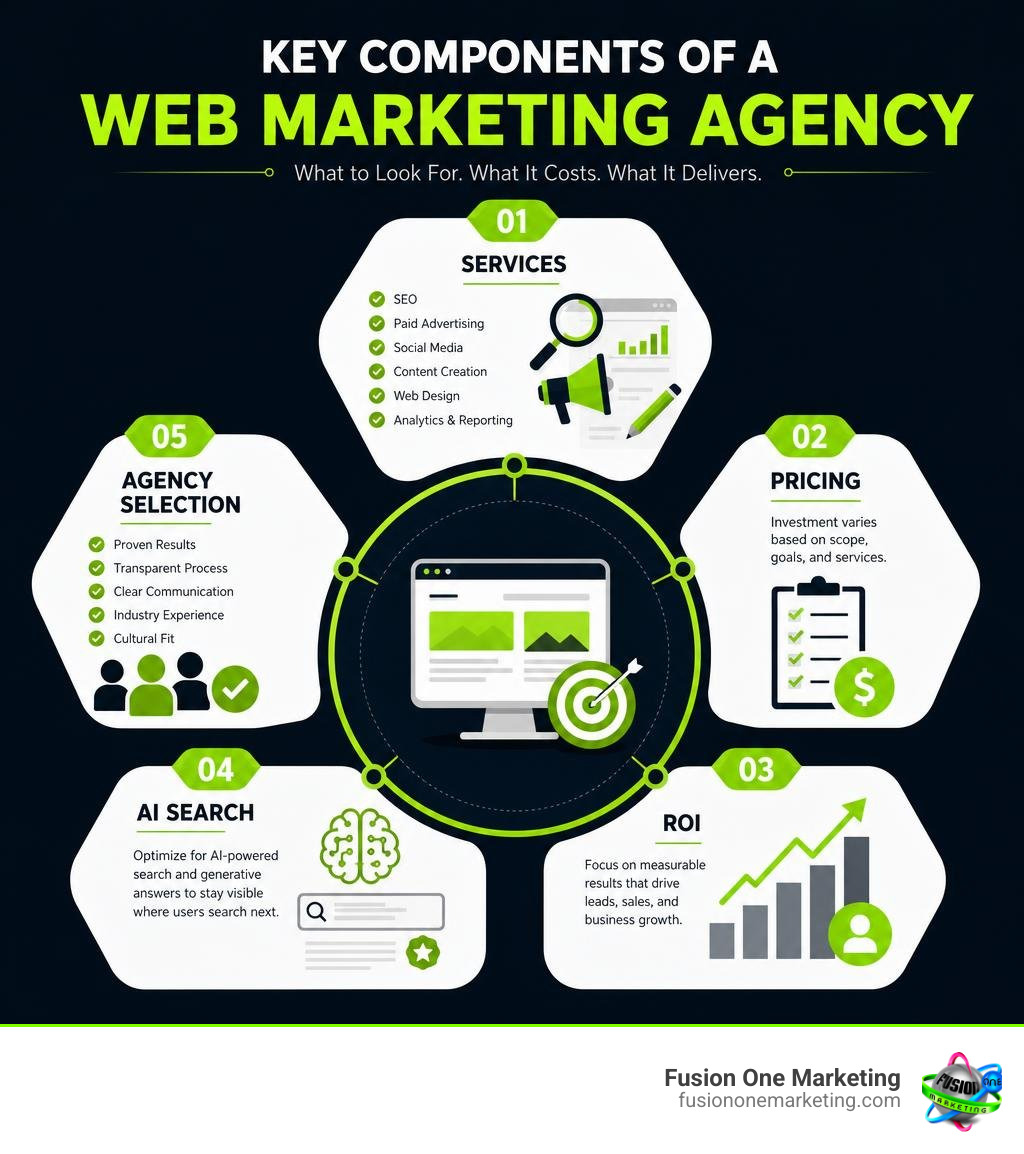
Core Services Offered by a Web Marketing Agency
To build a sustainable digital presence, a modern agency must offer a comprehensive, integrated suite of services. While some agencies specialize in only one area, a full-service partner understands what digital marketing can do for you by combining multiple disciplines under one strategy:
- Search Engine Optimization (SEO): Optimizing your website’s technical health, local signals, and content so search engines can easily find, crawl, and rank your pages.
- Pay-Per-Click (PPC) Advertising: Creating targeted paid campaigns on search engines and social platforms to capture high-intent leads immediately.
- Social Media Marketing & Advertising: Building brand relevance, engaging with your local community, and running targeted social ads to reach your exact demographic.
- Content Marketing: Producing high-quality, educational content (blogs, videos, and guides) that addresses your customers’ questions and builds industry authority.
- Web Design & Development: Building fast, responsive, and secure websites that act as 24/7 sales assets rather than passive online brochures.
- Conversion Rate Optimization (CRO): Analyzing user behavior on your site to fix “conversion leaks” and turn more passive visitors into paying customers.
Pricing Models and Contract Flexibility
Understanding how agencies charge is crucial to avoiding budget surprises. As you research digital marketing 101 what small businesses need to know, you will generally encounter three primary pricing structures:
- Hourly Rates: Typically ranging from $50 to $300+ per hour, depending on the agency’s size and expertise. This is common for one-off projects or consulting.
- Monthly Retainers: A flat monthly fee for a set scope of ongoing work (e.g., managing your SEO, PPC, and content). This is the most common model for long-term growth.
- Outcome-Based or Performance Bidding: Pricing tied directly to specific performance guarantees or revenue milestones.
One major point of differentiation among agencies in 2026 is contract flexibility. Many traditional agencies try to lock clients into rigid 12-month agreements. However, we believe that month-to-month agreements are far superior because they force an agency to prove its value every single day. If an agency is confident in its ability to generate leads, it won’t need to trap you in a long-term contract.
Expected ROI and Performance Metrics
Investing in a web marketing agency should never feel like a gamble. You should expect clear, measurable returns. However, the exact timeline and metrics will depend on the channels you use. To understand why digital marketing is not a one time project, it helps to look at industry-standard benchmarks:
- Paid Media & PPC: Typically delivers rapid results (within 30 to 60 days). Across the industry, high-performing campaigns can generate massive returns—sometimes reaching up to a 23X return on ad spend (ROAS) for highly optimized campaigns, though a 4X to 5X return is a more common, healthy benchmark for local service businesses.
- SEO & Organic Growth: A long-term play that compounds over time, usually taking 120 to 180 days to show significant traction. When executed correctly, local campaigns can see incredible year-over-year growth, such as a 400%+ increase in top organic keyword rankings and a 60%+ boost in organic conversions within the first six months.
- Connected Revenue Marketing: By connecting your website and marketing campaigns directly to your CRM (Customer Relationship Management) system, businesses can see an average of 15% higher marketing ROI within the first six months. This closed-loop tracking ensures that every lead, click, and dollar spent is fully accounted for.
Navigating the AI Era: How Agencies Optimize for Modern Search

We cannot talk about digital marketing in 2026 without talking about Artificial Intelligence. Search has evolved from a simple list of “10 blue links” into a dynamic, conversational experience. Today, users are bypassing traditional search boxes entirely, turning instead to AI-driven assistants like ChatGPT, Gemini, Perplexity, and Google AI Overviews to get instant, synthesized answers.
This shift means that traditional SEO is no longer enough. To stay visible, modern agencies must implement Generative Engine Optimization (GEO) and Answer Engine Optimization (AEO). If your business is not actively optimized to be cited inside these AI-generated answers, you are missing out on a rapidly growing share of real-world discovery. To learn more about this transition, check out our guide on digital marketing ai what you should know.
Adapting to AI-Driven Search and LLMs
Optimizing for AI search engines requires a completely different playbook than traditional keyword targeting. Because Large Language Models (LLMs) synthesize information from multiple sources to answer complex, layered queries, agencies must focus on building deep topical authority.
To do this, agencies utilize advanced digital marketing tools business should use to track and optimize for AI visibility:
- Passage-Level Targeting: Structuring your website content to directly answer highly specific, natural-language questions, making it easy for AI models to extract and cite your pages.
- Semantic Comprehension: Writing content in a natural, conversational tone that aligns with how people actually speak to AI assistants, rather than stuffing keywords.
- Retrieval-Augmented Generation (RAG) Alignment: Ensuring your brand’s data is clean, structured, and easily digestible so AI models can retrieve it accurately without “hallucinating.”
- Digital PR and Citation Building: LLMs rely heavily on trusted third-party validation. Building high-quality external mentions on authoritative local sites, forums, and directories is critical to getting your brand recommended by AI.
The results of adapting to this new frontier are massive. In the broader marketing landscape, businesses adopting AI SEO strategies have seen referral traffic from ChatGPT and other LLMs skyrocket by over 2,000%, alongside substantial traffic increases from Google AI Overviews and Gemini search optimization.

The Role of Creative Storytelling and Branding
While data, algorithms, and AI are incredibly important, they are only half of the equation. To truly stand out, a data-driven digital marketing strategy must be balanced with creative storytelling and strong brand identity. After all, an AI tool can help a customer find your business, but it is your brand’s story, values, and reputation that will convince them to buy from you.
This is especially true when targeting younger demographics. For example, Gen Z consumers are highly visual and interactive; 70% of Gen Z have already purchased products through live shopping, a multi-billion-dollar market that is growing by 30% every year.
Whether you are a local plumbing company in Birmingham, AL or a retail brand, your marketing must speak to consumers as individuals. By combining technical precision with authentic, engaging creative assets—like high-quality video production, custom graphics, and transparent customer reviews—you can show potential clients exactly what digital marketing can do for your business.
Choosing the Right Partner: Full-Service vs. Specialized Agencies
When searching for a web marketing agency, you will quickly realize you have to choose between two main types of providers: specialized (niche) agencies and full-service agencies.
A specialized agency focuses on one specific channel—such as only running Google Ads or only building websites. While they may have deep expertise in that single area, they often fail to see the bigger picture, resulting in disconnected marketing campaigns that compete against each other.
A full-service agency, on the other hand, takes a holistic approach. They build an integrated “revenue engine” where your website, SEO, paid ads, and social media all work together. For small and local businesses, this unified approach is almost always more cost-effective and successful because it prevents disconnected services and shortens the payback period on your marketing spend.
To help you compare, here is a quick breakdown of how these two models stack up:
| Feature | Full-Service Agency | Specialized Agency |
|---|---|---|
| Strategy | Unified, multi-channel strategy | Single-channel focus |
| Data & Tracking | Integrated, full-funnel attribution | Isolated channel metrics |
| Communication | One dedicated point of contact | Multiple vendors to manage |
| Cost Efficiency | High (services are bundled) | Lower (paying multiple separate retainers) |
| Best For | Consistent, scalable lead generation | One-off projects (e.g., a logo redesign) |
Working with a full-service agency also helps you avoid common digital marketing mistakes and how to avoid them, such as over-investing in paid ads when your website is too slow to actually convert those clicks into customers.
How to Vet a Web Marketing Agency Using Case Studies and Reviews
You shouldn’t take an agency’s claims at face value. A reliable agency will have a proven track record of success that they are proud to share. When vetting potential partners, look closely at their digital marketing case studies and third-party reviews:
- Look for Verifiable Reviews: Check independent platforms like Clutch, Google Business Profiles, and local directories. A reputable agency should have a high volume of positive reviews (for example, we are proud of our 5-star reputation in Alabama).
- Read the Details: Don’t just look at the star rating. Read the written feedback to see how the agency handles communication, project management, and cultural fit. Do they feel like a teammate, or just another distant vendor?
- Examine Industry Awards: While not the only metric, industry recognition and performance honors can help verify an agency’s credibility and commitment to staying at the forefront of the industry.
- Review Local Resources: If you are exploring the regional landscape, you can check directories like the Top Digital Marketing Agencies in Alabama to understand local design standards and find reputable local partners.
Red Flags and Common Mistakes in Agency Selection
Choosing the wrong agency can cost you thousands of dollars and months of wasted time. To protect your business, keep an eye out for these common red flags and avoid these 5 mistakes with digital marketing:
- Guaranteed Rankings: No one can “guarantee” a #1 spot on Google or AI search engines because search algorithms are constantly changing. If an agency promises this, run away.
- Vanity Metric Reporting: If an agency only reports on clicks, impressions, or likes, they are grading their own homework. Demand reports that focus on actual business outcomes, like leads, phone calls, and revenue.
- Lack of Transparency: You should always have direct, open access to your marketing dashboards (like Google Analytics and Google Ads) so you can audit performance daily.
- Data Ownership Issues: Make sure your contract states that you own your website, your domain, your ad accounts, and your creative assets. Some shady agencies will try to withhold your data if you decide to leave.
Frequently Asked Questions about Digital Marketing
Navigating online marketing can be overwhelming, and it’s completely normal to have questions before partnering with an agency. To help you get started, we’ve compiled answers to some of our digital marketing our most frequently asked questions.
How long does it take to see results from digital marketing?
The timeline for seeing a return on your investment depends heavily on the specific strategies you are running. To avoid common 5 mistakes small business owners make, it’s important to have realistic expectations:
- Paid Ads (PPC) and CRO: You can typically expect to see qualified leads and conversion improvements within the first 30 to 60 days of launching a campaign.
- SEO and Content Marketing: These are long-term strategies that build compounding value over time. It generally takes 120 to 180 days to see significant, sustainable growth in organic traffic and local rankings.
Why is a digital marketing audit necessary before starting?
A professional digital marketing audit is the foundational first step of any successful marketing campaign. Think of it like a doctor’s checkup; you wouldn’t want a doctor to prescribe treatment before diagnosing the issue. An audit allows an agency to:
- Evaluate your website’s technical health, speed, and mobile responsiveness
- Identify “conversion leaks” where potential customers are leaving your site
- Analyze your competitors’ rankings, ad spend, and local visibility
- Review your current tracking setup to ensure all leads and phone calls are being measured accurately
What is the difference between digital marketing and traditional advertising?
While traditional advertising (billboards, TV, radio, print) still has its place, digital marketing offers several massive advantages for modern businesses. When looking at digital marketing fact vs fiction, the key differences come down to targeting and measurability:
- Hyper-Targeted Audience Reach: Traditional ads are broadcast to a mass audience, hoping the right person sees them. Digital marketing allows you to target users based on their exact search intent, location, demographics, and behaviors.
- Measurable ROI: With traditional ads, it is incredibly difficult to know exactly how many sales came from a specific billboard. Digital marketing allows us to track every single click, form submission, phone call, and closed sale back to the exact campaign that generated it.
- Real-Time Optimization: Once a print ad is published, you cannot change it. With digital marketing, we can monitor campaign performance in real-time and make instant adjustments to maximize your budget efficiency.
Conclusion
Finding a reliable web marketing agency doesn’t have to be a stressful or frustrating process. By focusing on agencies that offer transparent reporting, flexible month-to-month contracts, and integrated, multi-channel strategies, you can find a partner that acts as a true extension of your team.
At Fusion One Marketing, we’ve spent over 15 years helping local businesses—especially in home services like HVAC, plumbing, and roofing—navigate the ever-changing digital landscape. Our signature “Digital Domination” program is designed to deliver a completely integrated strategy, combining high-performing web design, local SEO, paid ads, and social media to drive predictable, measurable growth for your business.
We are proud to serve our local communities across Alabama, with offices and dedicated teams in:
- Helena, AL digital marketing agency services
- Birmingham, AL digital marketing agency services
- Huntsville, AL and the surrounding regions
If you are ready to stop wasting money on disconnected marketing campaigns and start building a real revenue engine, we are here to help. Ready to grow? Explore our services and contact us today to request your free, comprehensive digital marketing audit!