

Automate Google Review Collection Without Chasing Every Customer
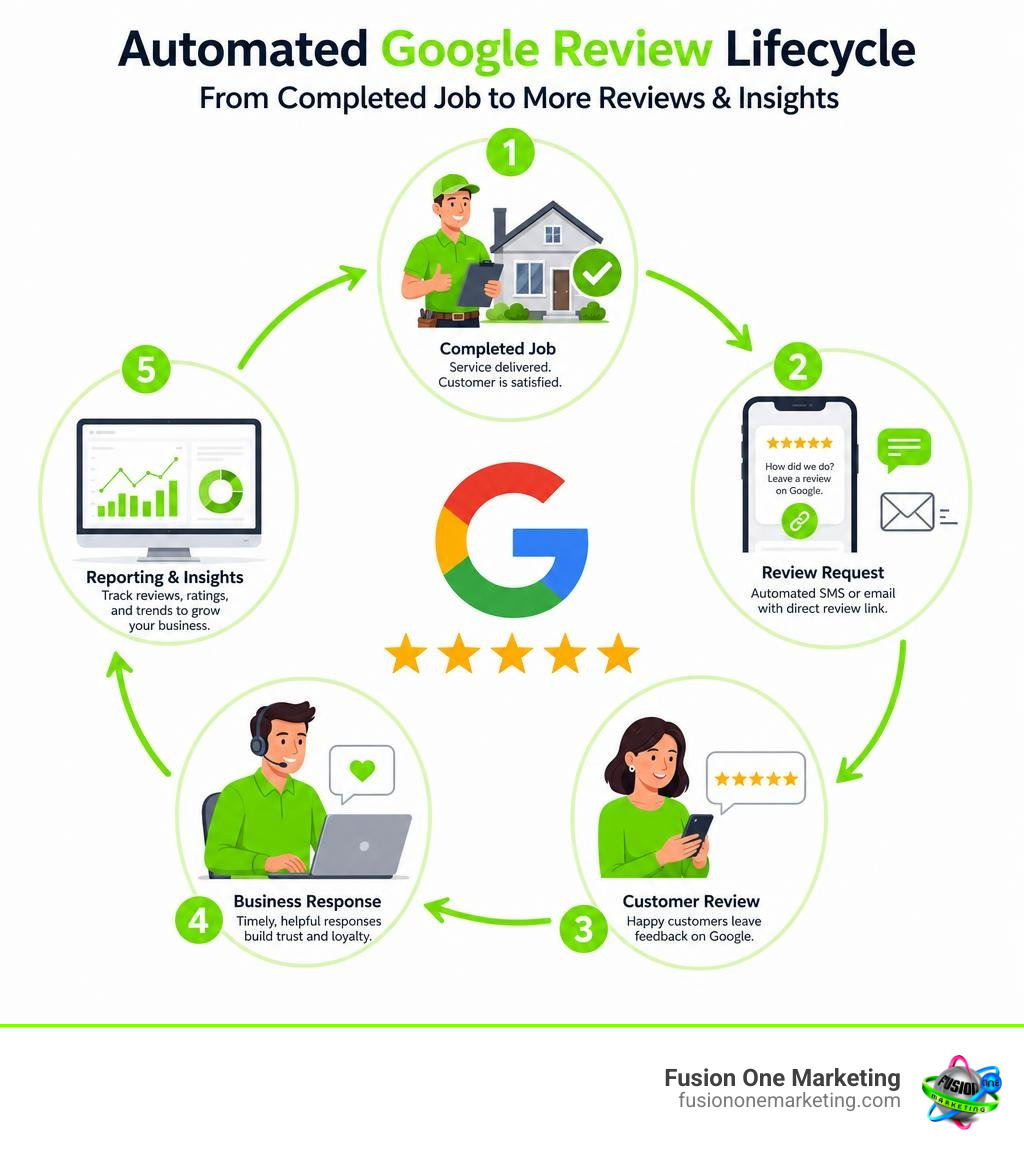
Google review automation sends a simple review request after a completed job or purchase, then helps you track and respond to the feedback that follows. For a home service business, start by connecting your CRM, invoicing, or field-service software to a review platform, sending a direct Google review link by SMS or email after service, and adding one or two polite follow-ups for customers who do not respond.
The goal is not to manufacture five-star ratings. It is to make it easy for every real customer to share an honest experience while the job is still fresh.
That matters because 81% of consumers use Google reviews to evaluate local businesses, and recent feedback carries extra weight: 73% of customers focus only on reviews from the past month. A steady, ethical review process can build trust, improve local visibility, and give busy owners a clearer view of what customers value or want fixed.
This guide compares Google review manager tools for collection, monitoring, AI-assisted responses, and reporting – with a close look at compliance features that help you avoid review gating, incentives, and fake-review bots.
Rob Humm is an owner of Fusion One Marketing and has worked in local search and digital marketing since 2011. His experience with Google review automation helps local businesses turn completed jobs into a more consistent, honest stream of customer feedback and stronger local visibility.
Related content about google review automation:
Why Customer Feedback Automation Is Essential for Local SEO

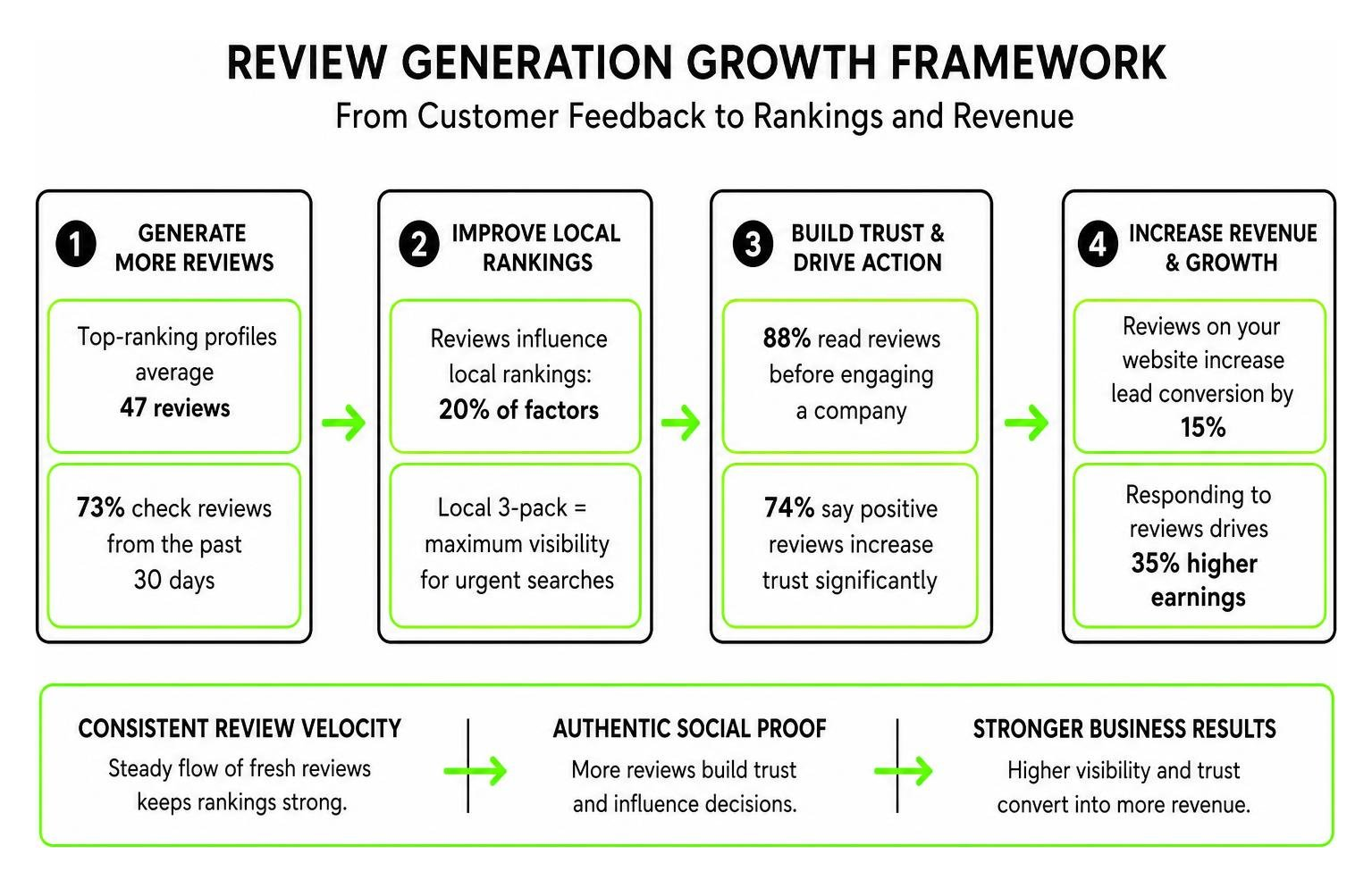
When homeowners search for an urgent plumber or air conditioning specialist, Google’s local 3-pack is the digital storefront that captures immediate attention. Achieving high rankings in these local search results is not accidental. User reviews directly influence the local search algorithms, accounting for roughly 20% of local search ranking factors.
Understanding why reviews matter comes down to two major elements: consumer trust and algorithmic proof. A commanding 88% of consumers read Google reviews before engaging a company, and 74% confirm that positive feedback makes them trust a local business significantly more. If your listing displays an outdated rating or only a handful of entries, potential customers naturally scroll to a competitor with dozens of fresh, verified endorsements.
Review velocity—the consistent arrival of new feedback over time—is critical. Google does not merely tally total star scores; it evaluates recency. With 73% of prospects exclusively checking reviews written within the past thirty days, relying on glowing reviews gathered three years ago simply will not sustain your search positions.
So, do Google reviews impact your SEO? The data is definitive: top-ranking Google Business Profiles average 47 customer reviews. Maintaining this steady baseline manually is challenging for busy trade professionals, which makes automated request workflows essential for staying ahead of competitors.
Core Capabilities of Google Review Automation Platforms
Automating your customer feedback loop goes well beyond sending a single automated text message. Modern review management infrastructure provides comprehensive operational control over your public reputation:
- Centralized Review Dashboard: Aggregate all inbound customer feedback across multiple locations into a single pane of glass, eliminating the need to log into multiple profiles daily.
- Sentiment Analysis & Tagging: Automatically categorize incoming feedback by service type, technician, or core sentiment to identify service bottlenecks or recurring compliments.
- True Unrounded Rating Tracking: Public profiles round scores to a single decimal, which often hides marginal drops. Advanced platforms calculate true mathematical averages to help you spot performance shifts early.
- Multi-Location Attribution: Connect review entries directly to corresponding service branches, work orders, or field technicians through CRM metadata integration.
Integrating these systems highlights the benefits of marketing automation tools, enabling small service operations to manage multi-location marketing effortlessly while keeping their focus on delivering exceptional field services.
The Business Impact of Continuous Review Generation
Consistently generating reviews transforms passive customer satisfaction into direct revenue growth. Featuring authentic customer reviews on your website can increase overall lead conversion rates by 15%. When potential customers see an active stream of positive feedback, their confidence in booking a service increases immediately.
Furthermore, businesses that actively engage with and respond to customer reviews experience an average of 35% higher earnings compared to companies that neglect their public listings.
Learning how to get more 5-star reviews online safely requires systems that make leaving a review effortless for the customer. With automated, one-tap mobile review links, businesses routinely scale from a modest few reviews per month to thirty or more consistent submissions, helping them build competitive dominance in their service areas.
How Automated Review Management Software Operates
Modern review management platforms operate directly behind the scenes by integrating with your existing business management software, Point of Sale (POS) system, or Customer Relationship Management (CRM) tools.
Instead of requiring technicians or office managers to send individual review requests manually, the automation system listens for specific operational triggers using secure API connections or webhooks. Common triggers include:
- A technician marking a work order as “Complete” in field management software.
- An invoice status changing to “Paid” inside your accounting platform.
- A follow-up email being dispatched with an automated BCC address linked to your review platform.
Once triggered, the platform dispatches a customized, mobile-optimized review invitation directly to the client’s smartphone via SMS or email. The message includes a direct URL linking straight to your Google Business Profile’s review dialogue box, removing every technical barrier for the homeowner.
Setting Up Multi-Channel Google Review Automation Triggers
To capture maximum response rates, review requests must be timed precisely and delivered through the customer’s preferred communication channel.
SMS remains the most responsive medium, delivering high open rates when sent while the positive experience is fresh in the customer’s mind. For field service contractors, dispatching an automated SMS approximately 24 hours post-service strikes the ideal balance—giving the homeowner adequate time to appreciate the completed repair while keeping the quality of service top-of-mind.
A structured multi-touch outreach cadence typically includes:
- Day 1 (Initial Request): A friendly, concise SMS sent 24 hours after service completion containing a direct one-tap Google review link.
- Day 3 (First Follow-up): A gentle email reminder sent only to customers who have not yet clicked the initial link.
- Day 7 (Final Touchpoint): A polite closing follow-up emphasizing how much your local team values authentic feedback.
In-person service teams can also deploy physical QR code checkpoints on invoices, service leave-behinds, or branded magnets. Combining digital follow-ups with physical touchpoints is an easy way to understand how to score free Google reviews and make your competitors jealous by engaging happy customers across every touchpoint.
AI-Assisted Review Response and Sentiment Monitoring
Securing positive feedback is only half the battle; maintaining an active, communicative presence by answering every submission is equally essential.
Modern review platforms use generative AI models that adapt to your historical reply style to draft authentic, professional responses in seconds. These models extract specifics mentioned in the customer’s review—such as the technician’s name or the specific repair performed—and craft a unique, context-rich response rather than a generic boilerplate thank-you.
To maintain operational control, review systems can route different ratings through distinct workflows:
- Positive Reviews (4-5 Stars): AI drafts can be set to auto-publish instantly or queued for quick one-click approval by your marketing coordinator.
- Critical Feedback (1-3 Stars): Automated systems can route negative reviews directly to an urgent escalation channel (like a private Slack webhook or an on-call manager’s inbox) for swift, personalized human intervention.
Reviewing customer sentiment this way shows how to leverage customer reviews and testimonials to boost your online reputation while resolving private customer service issues before they impact your broader brand reputation.
Essential Features to Compare in Review Automation Platforms
Selecting the right software to manage your local reputation requires evaluating workflow capabilities, compliance safeguards, and technical integrations. Here is how essential feature sets compare across common automation approaches:
| Feature & Capability | Standard DIY API Scripts | Mid-Tier Review SaaS | Enterprise Reputation Platforms |
|---|---|---|---|
| Outreach Channels | Webhook Email / Basic SMS | Multi-Channel SMS & Email | SMS, Email, WhatsApp, Social |
| Trigger Integrations | Custom Zapier Webhooks | 500+ Native CRM / POS Connectors | Full Enterprise API & Custom ERP |
| Follow-up Cadence | Single Trigger Send | Automated Multi-Day Sequences (Day 1, 3, 7) | Advanced Dynamic Segmentation |
| AI Response Engine | Raw LLM API Integration | Context-Aware & Brand-Trained AI | Custom LLM Multi-Lingual Agents |
| Alert Routing | Basic Email / Slack Alerts | Multi-Department Webhooks & Queues | Enterprise Helpdesk Integration |
| Schema & Display Widgets | Manual Web Embeds | Dynamic CSS Widgets + Rich Snippets | Headless API Widget Distribution |
| Compliance Safeguards | Manual Review Rules | Built-in Anti-Gating Protections | Strict Enterprise Governance Filters |
| Average Cost Profile | $20–$50 / mo (API costs) | $59–$150 / mo | $300–$600+ / mo (Annual lock-ins) |
When shopping for software, ensure your selection aligns with the basics of online reputation management, giving your team all the automation power it needs without paying for bloated enterprise features your staff will never touch.
White-Hat Collection vs Black-Hat Review Bots
As local search competition intensifies, some operators turn to black-hat shortcuts like automated review bots, proxy rotators, and artificial accounts to inflate star ratings quickly.
Looking at open-source technical automation documentation, these illegitimate tools rely on browser automation scripts (such as Selenium), rotating IP proxies, and LLM text generation to manufacture fake submissions without real customer involvement.
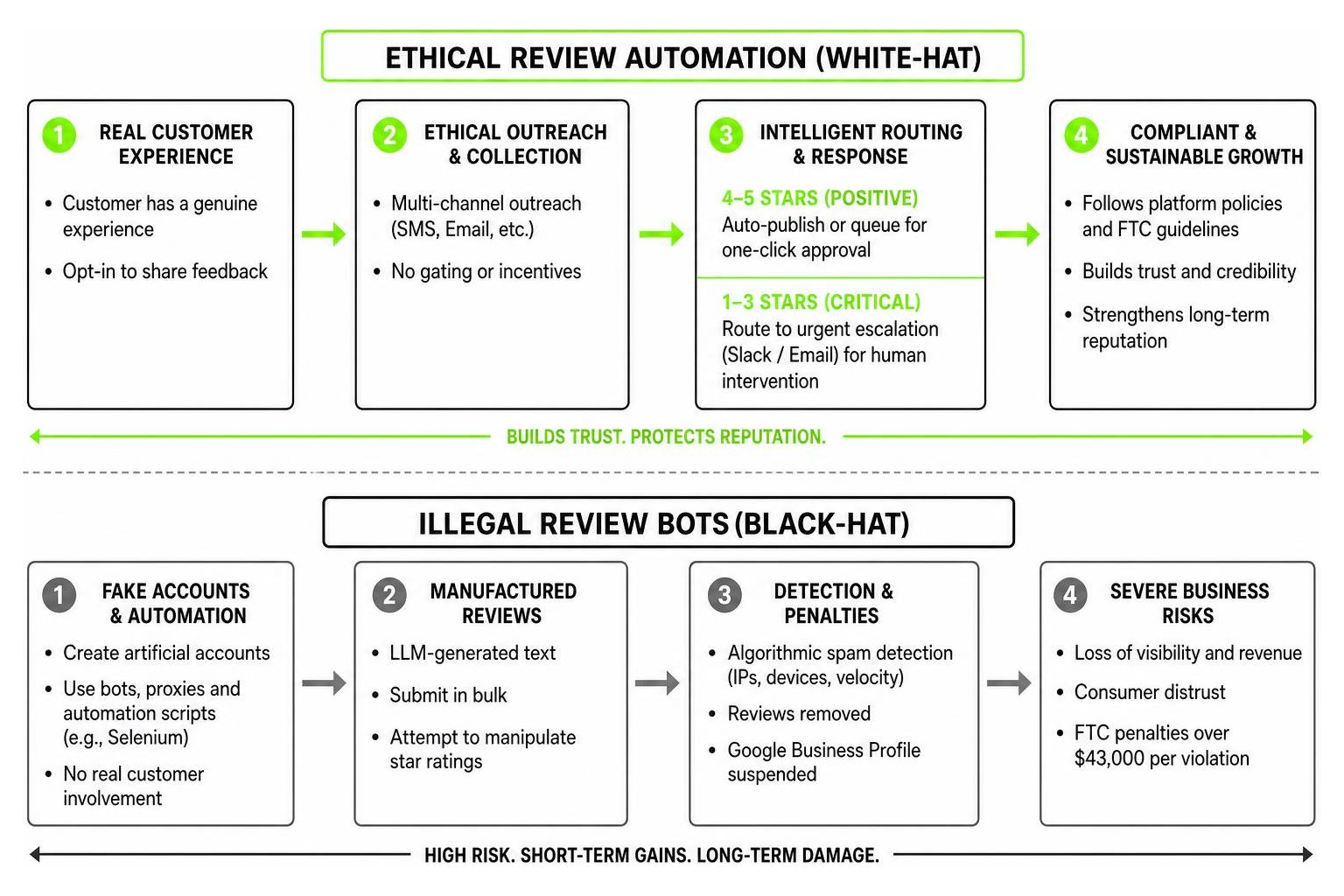
Relying on artificial review bots introduces severe business risks:
- Algorithmic Spam Detection: Google actively monitors IP networks, device fingerprints, and unnatural review velocity spikes. In 2020 alone, Google scrubbed over 55 million policy-violating reviews, often permanently suspending associated Google Business Profiles.
- Consumer Distrust: Roughly 50% of consumers report spotting fake reviews online. If prospective clients suspect inauthentic praise, trust evaporates immediately.
- Severe Legal Penalties: The Federal Trade Commission (FTC) enforces strict penalties against deceptive endorsements and fake online reviews, with fines exceeding $43,000 per violation.
Ethical, white-hat review automation never manufactures content. Instead, it creates an efficient bridge between your real completed jobs and legitimate customer experiences.
Navigating Google Policies and FTC Compliance Guidelines
To protect your business profile from algorithmic penalties or manual actions, your automated workflows must adhere strictly to Google’s Business Profile policies and FTC endorsement standards.
- Strict Prohibition of Review Gating: You cannot prescreen customers by asking if they had a positive experience and then only sending Google review links to happy clients while diverting unhappy customers to private forms. Every customer must receive equal, unfiltered access to leave public feedback.
- No Review Incentives: Offering discounts, gift cards, loyalty points, or contest entries in exchange for Google reviews violates Google’s Terms of Service and FTC truth-in-advertising regulations.
- Authentic Customer Verification: Ensure that review requests are dispatched only to real individuals who have completed an actual transaction or service visit with your company.
By following the ultimate guide to getting more Google reviews ethically, you can protect your company’s digital footprint while steadily climbing local search rankings.
Frequently Asked Questions About Google Review Automation
Is automated review collection compliant with Google guidelines?
Yes, automated review collection is fully compliant with Google guidelines as long as your process does not involve review gating, incentivization, or fake feedback.
Google actively encourages businesses to remind their real customers to share feedback. Automating this outreach via CRM triggers, transactional receipts, or polite follow-up messages is a standard and supported method for online reputation management.
To stay compliant:
- Ensure all customers receive identical review links regardless of their sentiment.
- Never offer financial rewards or discounts for reviews.
- Provide clear, uninhibited access to your Google Business Profile.
When is the ideal time to trigger an automated review request?
The ideal time to trigger an automated review request for home service businesses is approximately 24 hours after a job is marked complete.
Sending a request instantly while a technician is still packing up can feel intrusive, while waiting several weeks leads to poor conversion because the customer has moved on. A 24-hour buffer allows the homeowner to experience the completed repair, test their new installation, and appreciate the quality of your work, resulting in substantially higher response rates.
How does automating review collection increase website conversion rates?
Automating review collection increases website conversions by ensuring a steady stream of verified social proof that can be displayed directly on key landing pages.
Dynamic review widgets embed real-time Google feedback across your site, reinforcing trust at the exact moment a prospect is deciding whether to call. Additionally, implementing structured schema markup alongside your reviews helps search engines display rich star rating snippets beneath your organic search results, driving higher click-through rates and customer confidence.
Conclusion
Building a dominant local reputation across competitive service sectors does not require chasing every customer manually or risking your business profile with questionable shortcuts. By implementing a compliant, transparent Google review automation strategy, you can turn daily service calls into a steady engine for organic growth, community trust, and top-tier local search visibility.
At Fusion One Marketing, our dedicated Digital Domination program combines high-performance local SEO, advanced review workflows, modern web design, and targeted paid advertising to help home service contractors and local businesses achieve sustainable market leadership.
Discover how to get more company reviews and grow your business today by partnering with our expert team to build a scalable, automated reputation strategy that drives real results.