

Why HVAC Lead Generation Determines Whether Your Business Grows or Stalls
HVAC lead generation is the process of attracting homeowners and businesses who need heating, cooling, or maintenance services — and turning their interest into booked jobs.
Quick answer: The most effective HVAC lead generation strategies in 2026
- Google Local Services Ads (LSAs) — pay only per verified call, shows up at the very top of search results
- Local SEO + Google Business Profile — captures the 80% of customers who start their search online
- Exclusive pay-per-lead services — one contractor per lead, 25–40% close rates vs. 10–20% on shared leads
- Paid search (Google Ads / PPC) — connects you with buyers who are 50% more likely to convert
- Online reviews and reputation management — 88% of homeowners check reviews before choosing an HVAC company
- Email marketing and seasonal campaigns — fills slow seasons with maintenance calls and tune-up bookings
- Content marketing — generates 54% more leads than traditional outbound marketing over time
Running an HVAC business means you’re already juggling dispatching, quoting, and keeping customers happy. Finding time to fill the pipeline is a different challenge entirely.
Here’s the reality: most HVAC companies either have too few leads in the off-season or too many missed calls during peak heat waves. Neither extreme is sustainable.
The U.S. HVAC market is projected to reach $35.8 billion by 2030, and searches for HVAC repair have grown 20% year-over-year. The demand is real — but so is the competition. More contractors are fighting for the same homeowners on the same platforms, often paying $40–$150 for shared leads they split with three or four competitors.
The contractors who win aren’t necessarily the biggest or cheapest. They’re the ones with a system — one that generates consistent, high-intent leads across multiple channels, converts them quickly, and keeps customers coming back.
This guide breaks down exactly how to build that system, whether you’re starting from scratch or trying to get more from what you’re already spending.
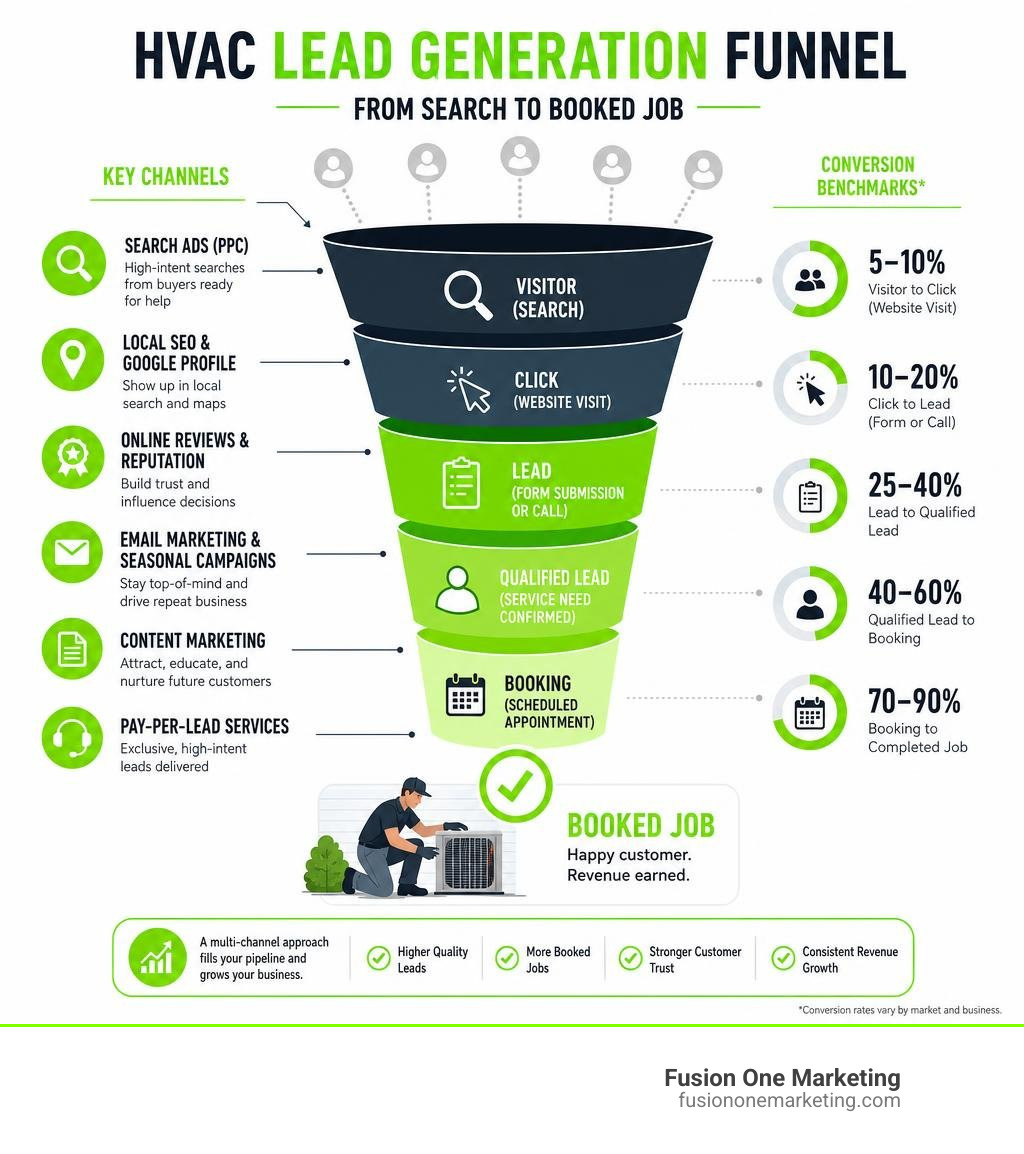
The Economics of HVAC Lead Generation: Costs, ROI, and Buying vs. Earning
To build a healthy sales pipeline, you must understand the math behind your marketing. Too many contractors treat marketing like a slot machine—they throw money in and hope for the best. Instead, we need to treat it like a predictable engine.
First, let’s look at the average cost per lead (CPL). In the HVAC industry, lead costs typically range from $75 to $300 per lead on average. Why such a wide range? It depends heavily on your location, competition, and the specific channel you are using. For example, if you are bidding on high-intent terms in metro areas like Birmingham or Huntsville, your paid search CPL will naturally be higher than in smaller markets like Helena.
However, the cost of the lead is only half the equation. The real metric that matters is your Return on Investment (ROI). If you spend $150 on a lead but close a $12,000 complete system replacement, that CPL is incredibly cheap. For instance, contractors utilizing exclusive pay-per-call networks often report spending around $30,000 annually to generate over $400,000 in booked business. To get a grasp on how these pieces fit together, check out our guide on Lead Generation 101.
When setting up your system, you will face a critical choice: Buying leads vs. Earning leads organically.
Exclusive Leads vs. Shared Leads
If you decide to buy leads, you must know the difference between exclusive and shared models. Shared lead platforms sell the exact same homeowner contact info to 3 to 5 different contractors simultaneously. This triggers an immediate, stressful “race to the bottom” on pricing.
Conversely, exclusive lead systems deliver the homeowner’s inquiry directly to you and only you. This drastically improves your close rates.
| Metric | Shared Leads (e.g., Angi, HomeAdvisor) | Exclusive Leads (e.g., Pay-per-Call, Owned Ads) |
|---|---|---|
| Average Cost | $40 – $150 per lead | $75 – $300 per lead |
| Competition | High (3-5 contractors call immediately) | Zero (It is exclusively yours) |
| Conversion Rate | 10% – 20% | 25% – 40% |
| Average Customer Lifetime Value | Lower (transactional, price-shoppers) | $3,500 – $5,000 |
| Appointment Setting Rate | 20% – 35% | 70% – 80% |
While buying exclusive leads acts as an excellent short-term bridge to keep your trucks moving, the holy grail is earning your own leads organically. Building an owned marketing pipeline (through your website and local search presence) takes 3 to 6 months to mature, but the long-term economics are unbeatable. An organic lead might cost you $100 to $200 to generate in year one, but by year three, those compounding organic rankings drop your cost per lead down into the single digits.
Organic and Paid Search Strategies for HVAC Contractors
When a homeowner’s air conditioner stops working in the middle of a sweltering Alabama July, they don’t wait around. They grab their phone and search. Capturing this high-intent search traffic is the single fastest way to grow your customer acquisition. For a broad look at how to position your home services business, explore our Marketing Tips for Home Services Industry.
Why Local SEO is the Backbone of Organic HVAC Lead Generation
Organic search engine visibility is your most valuable long-term asset. Because 80% of local searches convert into action, you want your business to be the first one they see. This is where Local SEO comes into play.
To dominate local search, your strategy must center around your Google Business Profile (GBP) and the local Map Pack. The Map Pack captures roughly half of all local HVAC clicks. If your business isn’t showing up in the top three map results for “AC repair near me” in Birmingham or Helena, you are handing jobs directly to your competitors.
Here is how to optimize your organic presence:
- Claim and Complete Your GBP: Ensure your business name, address, and phone number (NAP) are identical across the web. Dive deep into the latest Google Business Profile Features to stand out.
- Build Location-Specific Pages: Don’t just target one massive region. Create dedicated service area pages on your website specifically optimized for Huntsville, Helena, and surrounding neighborhoods. Learn how with our guide on How to Optimize Your Website for Local Search.
- Avoid Duplicate Content: Make sure each local landing page has unique value—don’t just swap out the city names. Detail the specific local climate challenges, neighborhood landmarks, or local regulations of each area.
Paid Advertising Channels for Fast HVAC Lead Generation
If you need phone calls tomorrow, organic SEO won’t cut it. You need paid search. PPC ads connect your business with shoppers who are 50% more likely to make a purchase than organic visitors. To understand why, read about Why Paid Search Advertising is Essential for Local Businesses.
There are three primary paid channels you should use:
- Google Local Services Ads (LSAs): These sit at the very top of the search results page, even above traditional paid ads. They feature the “Google Screened” badge, which builds instant trust. Best of all, you pay per lead (actual calls or bookings) rather than per click.
- Traditional Google Search Ads (PPC): These allow you to target high-intent keywords like “emergency furnace replacement” or “AC repair Helena AL.” You pay when someone clicks your ad. For a deeper look at managing these budgets, check out our resources on Pay Per Click and PPC.
- Pay-per-Call Networks: Services like Exclusive HVAC Lead Generation – 33 Mile Radius or Exclusive HVAC Leads | Buy Verified HVAC Leads | ClearCutLeads deliver live phone calls directly to your dispatch team. You only pay for valid leads that meet pre-set criteria (e.g., an authorized homeowner in your service area requesting HVAC work).
If you are wondering how to balance your ad budget between search engines and social platforms, our breakdown on Google Ads or Facebook Ads: Which One is Better? offers excellent guidance. Additionally, check out local networks like Exclusive HVAC Leads in Alabama – $54.99 – 99 Calls to see how regional pricing models operate.
Navigating Seasonal Demand and Climate-Driven Leads
The HVAC industry is notorious for its seasonal revenue rollercoaster. In the spring and fall, the phones go quiet. In the summer and winter, your dispatchers are overwhelmed, and you are likely turning away profitable emergency calls because your techs are fully booked.
Escaping this feast-or-famine cycle requires proactive planning and a deep understanding of climate-driven demand.
In southern markets like Alabama, humidity control drives 35% to 40% of HVAC service calls outside of extreme temperature spikes. Systems designed for these humid climates face unique wear and tear. By educating your customers on the benefits of whole-home dehumidifiers, you can add $950 to $1,400 to standard projects while maintaining 28% higher margins than temperature-only service calls.
To flatten the seasonal curve, implement these strategies:
- Pre-Season Maintenance Agreements: Use the shoulder seasons (March to May and September to November) to run aggressive tune-up campaigns. Transitioning one-time repair customers into recurring maintenance agreements builds predictable, year-round recurring revenue.
- Weather-Triggered Preparedness: Monitor local weather forecasts closely. When a polar vortex or extreme summer heat wave is predicted, 40% to 50% of emergency business is captured by the contractor who reaches out first with preparedness tips, emergency scheduling options, or preemptive staffing.
- Leverage Energy Incentives: Use federal and regional energy efficiency mandates to close replacement deals during slower months. For instance, the Inflation Reduction Act offers up to $2,000 in rebates for heat pumps and $600 for SEER 16+ central air conditioners. Highlighting these savings in your fall and spring marketing can capture up to 60% more replacement projects.
For a deeper dive into targeting geographic and climate-driven opportunities, explore HVAC Leads – Select Location | PeakIntent .
Maximizing Lead Quality and Conversion Rates
Generating traffic is only half the battle. If your website is slow, confusing, or hard to use on a phone, you are wasting your marketing budget. To understand why your phone isn’t ringing despite getting web traffic, take a look at our article on Why Your Lead Quality is Struggling.
First, make sure your website is built for mobile users. Over 70% of AC repair searches happen on mobile devices. If a homeowner in Huntsville has water leaking from their attic unit, they want a fast, friction-free way to contact you.

To maximize your website’s conversion rates, focus on these technical and design elements:
- Speed is Money: Users expect sites to load in two seconds or less. A tiny 1% increase in page speed can boost conversions by 7%. Compress your images, clean up unnecessary code, and ensure your hosting is top-tier.
- Frictionless Contact Options: Don’t force users to fill out 10-field contact forms. Keep forms simple—just name, phone number, and service needed. Install a direct click-to-call button and a smart website chatbot that integrates with your scheduling CRM so users can book appointments directly.
- Define Your Target: Make sure you know what a high-value lead looks like for your specific business. Read our guide on What is a Good Lead? to align your marketing with your sales team’s expectations.
Reputation Management and Lead Nurturing Best Practices
Once a lead enters your system, the clock starts ticking. In the home services industry, speed to lead is everything. If you do not respond to an emergency lead within 15 minutes, the homeowner will simply move down the Google search results and call your competitor.
To ensure no lead slips through the cracks, implement automated follow-up systems. Set up an instant SMS text-back system for missed calls. If a customer calls while your dispatchers are on another line, an automated text should immediately go out: “Hi! We sorry we missed your call. How can we help you today?” This simple automation can recover up to 90% of missed calls during peak seasons.
Equally important to your inbound lead flow is your online reputation. 74% of consumers believe online reviews increase trust, and a product or service with just five reviews has a 270% greater purchase likelihood than one with none.
Here is how to build a dominant local reputation:
- Automate Review Requests: Don’t leave reviews to chance. Program your field management software to send a text or email review link immediately after a technician marks a job as complete. Explore our Top Tips for Requesting Google Reviews from Your Customers for proven scripts.
- Showcase Your Feedback: Positive feedback is highly persuasive. Learn how to highlight these wins with our guide on How to Leverage Customer Reviews and Testimonials to Boost Your Online Reputation.
- Respond to Every Review: Always reply to both positive and negative reviews professionally. If you get a bad review, don’t panic. Check out our strategies on How to Turn a Negative Review into a Positive Experience to protect your brand.
- Nurture Existing Customers: Email marketing produces 50% more sales than other lead generation channels. Send regular maintenance reminders, filter change alerts, and seasonal specials to keep your brand top-of-mind.
To see these strategies in action and explore modern follow-up tools, check out HVAC Lead Generation 2026 – YouTube and [HVAC Lead Generation 5 Tools That Generate Us 600+ … – YouTube for practical tech stacks.
For more inspiration on building review-gathering systems, read our guide on How to Get More Online Reviews for Your Pest Control Business—the same psychological triggers apply perfectly to HVAC!
Frequently Asked Questions About HVAC Leads
How much does the average HVAC lead cost?
The average hvac lead generation cost ranges from $75 to $300 per lead. In highly competitive Alabama markets like Birmingham or Huntsville, high-intent keywords can push costs to the higher end of the spectrum. However, utilizing targeted local strategies can help secure exclusive leads at a more predictable, cost-effective rate.
What is the difference between exclusive and shared HVAC leads?
Exclusive leads are delivered solely to your business, yielding conversion rates of 25% to 40% and an average customer lifetime value of $3,500 to $5,000. Shared leads are sold to 3 to 5 contractors simultaneously, resulting in lower close rates (10% to 20%) and forcing you to compete purely on price.
How do Google Local Services Ads (LSAs) work for HVAC contractors?
Google LSAs appear at the absolute top of Google search results. Contractors must pass a background check and license verification to earn the “Google Screened” badge. Instead of paying per click, you pay a flat rate per call or booking from qualified homeowners in your chosen service areas, such as Helena, Huntsville, or Birmingham.
Conclusion
Building a consistent, high-performing hvac lead generation system is not about chasing the latest marketing fad. It is about creating an integrated digital asset that you own and control.
At Fusion One Marketing, we help home service businesses escape the seasonal rollercoaster through our signature Digital Domination program. We don’t just build you a website or run a few ads in isolation. We deliver an all-in-one, integrated marketing strategy—combining custom web design, high-converting Local SEO, strategic PPC, social media, and reputation management—to drive measurable, long-term growth for your business.
Ready to stop renting shared leads and start dominating your local market?
Grow your business with Fusion One Marketing today, and let’s keep your trucks running and your pipeline full year-round.