

Why Most Landscaping Companies Struggle to Get Consistent Leads Online
If you’re looking to run a landscaping PPC campaign near me, here’s what you need to know right away:
What a local landscaping PPC campaign does:
- Places your business at the top of Google search results when homeowners search for services in your area
- Targets high-intent buyers — people ready to hire, not just browsing
- Generates calls and quote requests within days of launch
- Works across service types: lawn maintenance, hardscaping, design/build, and commercial grounds
- Delivers measurable cost-per-lead, typically between $25 and $50 for landscaping businesses
The U.S. landscaping industry generates over $176 billion in annual revenue — and 97% of customers start their search online. That’s a massive opportunity. But most landscaping companies are leaving it on the table.
Here’s the reality: the feast-or-famine cycle that plagues so many landscaping businesses isn’t just about seasonality. It’s about visibility. When a homeowner searches “landscaping company near me” in March, the crews that stay booked aren’t necessarily the best in the market — they’re just the most visible.
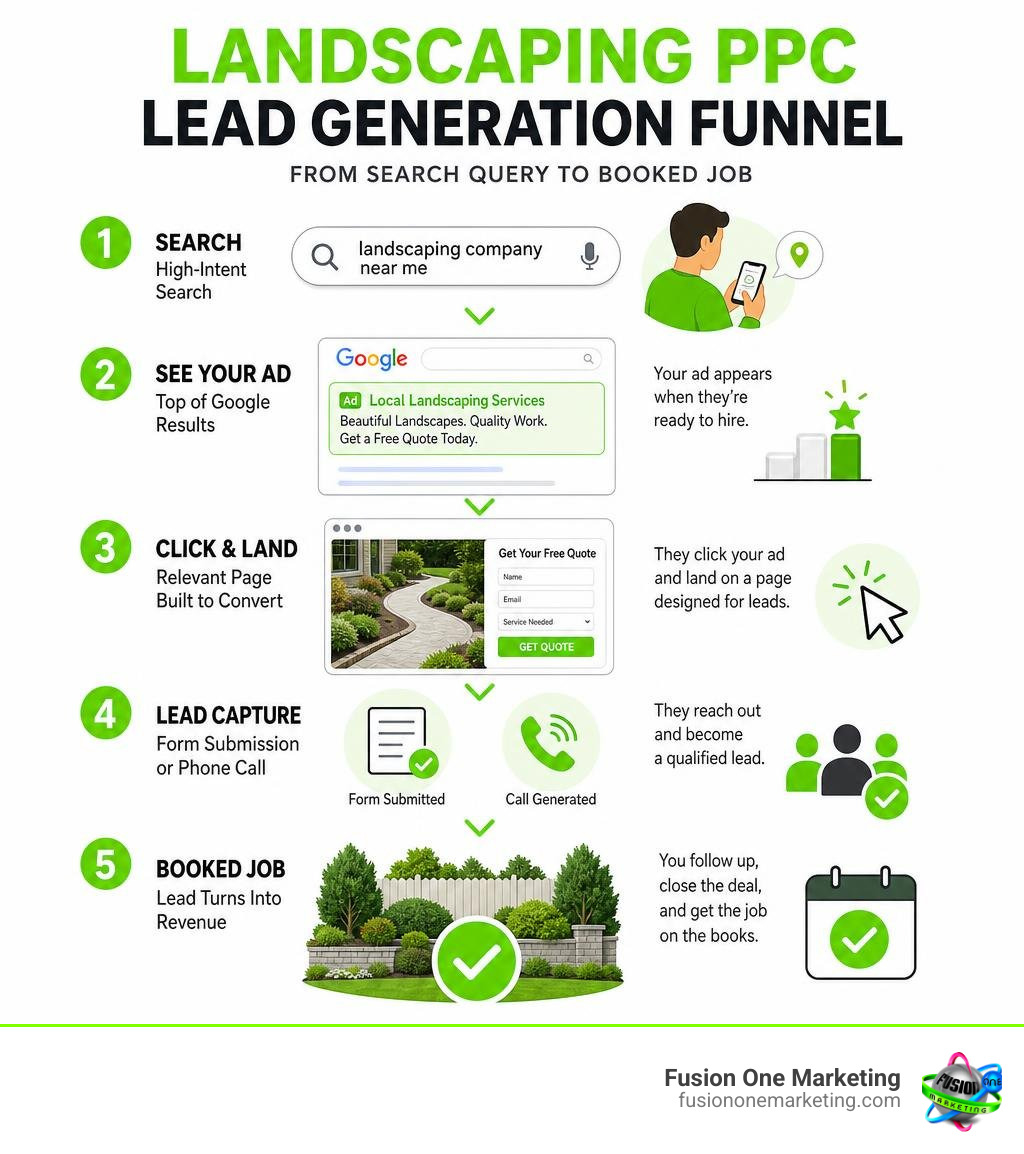
PPC advertising puts you in front of that homeowner at the exact moment they’re ready to call. Done right, it’s not an expense. It’s a lead engine.
But “done right” is the hard part. Most landscaping companies waste their ad budgets on the wrong keywords, send traffic to the wrong pages, and have no idea which clicks are actually turning into jobs.
This guide breaks down exactly how to fix that.
I’m Rob Humm, co-owner of Fusion One Marketing, and I’ve been building PPC strategies for local businesses since 2011 — including helping landscaping companies run smarter landscaping PPC campaigns near me that generate qualified leads without burning through their budgets. In this guide, I’ll walk you through the exact approach we use to help landscaping businesses get found, get calls, and grow predictably.
Why Landscaping PPC is Different from General Paid Search
Many general digital marketing agencies treat pay-per-click (PPC) advertising like a one-size-fits-all formula. They set up a basic campaign, target broad terms like “landscaping,” and point the traffic directly to your homepage.
In the landscaping world, this approach is a fast track to a drained bank account.
Landscaping PPC is highly specialized because your services are diverse, seasonal, and hyper-local. Unlike a standard e-commerce store or a national B2B software company, your business depends on physical proximity, regional climate shifts, and completely different customer profiles depending on the job.
To run a profitable campaign, you must implement a strict service-type separation strategy. This means dividing your advertising efforts into three distinct categories, each with its own budget, keyword targets, and messaging:
- Lawn Maintenance & Recurring Services: This targets homeowners looking for weekly mowing, fertilization, weed control, or seasonal cleanups. The search intent is immediate, and the buyer is looking for reliability and fair pricing.
- Design/Build & Hardscape Installation: This targets high-value projects like custom patios, retaining walls, outdoor kitchens, and complete backyard renovations. The sales cycle here is much longer, often spanning weeks or months of consideration.
- Commercial Grounds Maintenance: This targets property managers, HOA board members, and business owners. The search behavior is highly professional, and the decision-making process involves formal bids and long-term contracts.
Trying to run all of these services through a single, generic ad group is impossible because a homeowner looking for “weekly lawn mowing” has a completely different mindset than a commercial property manager looking for a multi-year maintenance contract.
By separating your campaigns, you can align your ad copy and budget with the specific search intent of each audience. Understanding these differences is why we believe Why Paid Search Advertising is Essential for Local Businesses who want to scale their operations efficiently.
How a Landscaping PPC Campaign Near Me Captures High-Intent Leads
When a homeowner in Birmingham, Huntsville, or Helena, AL sits at their kitchen table and types “landscaping ppc campaign near me” or “drainage contractor near me” into Google, they aren’t looking for a DIY tutorial. They have an active, immediate need.
By positioning your business at the very top of the search engine results page (SERP), you capture these high-intent local searchers at the exact moment they are ready to book an estimate.
This immediate visibility is critical because landscaping decisions are often made quickly, especially during seasonal transitions. If a homeowner’s backyard is flooding during a heavy Alabama spring rain, they will call the first reputable contractor they find.
To maximize the return on your ad spend, you need to understand the customer lifetime value (LTV) of these leads:
- Lawn Maintenance: A recurring lawn care client might cost $75 to acquire through PPC, but if they stay with you for three years at $180 per month, their lifetime value is over $6,400.
- Design/Build: A single patio or hardscaping lead might cost $150 to generate, but if it converts into a $25,000 outdoor living project, the acquisition cost becomes negligible.
To see how local targeting works in action for specific communities in our service area, take a look at how we structure local landing pages like Lawn Care & Landscaping Helena AL, Backyard Light Installer to speak directly to local homeowners.
Balancing Seasonal Demand and Budget Cycles
In Alabama, the landscaping calendar dictates your business flow. You can’t run your ads at the same flat budget in December as you do during the spring rush in March and April.
Successful landscaping PPC requires a dynamic seasonal demand calendar and proactive budget pacing.
During the spring surge (late February through April), search volume spikes dramatically. Homeowners are eager to clean up winter debris, lay fresh sod, and plan their summer outdoor projects. To capture this volume, your April budget should easily be three to four times your February spend.
In the off-season, rather than pausing your ads entirely—which destroys your campaign’s historical data and optimization momentum—you should shift your budget to promote winter consultations, commercial snow removal (if applicable), or early-spring project planning.
Managing these shifts requires a deep understanding of how bid pricing fluctuates. You can read more about how search volume impacts ad costs in our guide on Google Ads Cost Per Click.
Building a High-Converting Landscaping PPC Campaign Near Me

To build a campaign that actually fills your route sheets, you need a robust campaign architecture. This means leveraging both Google Search Ads and Google Local Services Ads (LSAs) to dominate the top of the search results.
For an in-depth breakdown of how to structure these systems from the ground up, refer to our comprehensive article on How to Run a Successful Google Ads Campaign.
Key Elements of a Landscaping PPC Campaign Near Me That Converts
Getting a homeowner to click your ad is only half the battle. The real magic happens when they land on your website and decide to call you instead of your competitor.
The biggest mistake we see landscapers make is sending paid traffic directly to their generic website homepage. We often say that sending PPC traffic to your homepage is like inviting someone to a gourmet restaurant and handing them a raw potato. It’s confusing, overwhelming, and results in a high bounce rate.
Instead, every campaign must use dedicated landing pages tailored specifically to the ad the user clicked:
- Match the Headline: If your ad is for “Sod Installation in Huntsville,” the landing page headline must say “Professional Sod Installation in Huntsville.”
- Mobile-First Design: Over 70% of local home service searches happen on smartphones. Your landing page must load in under two seconds and feature a prominent, clickable “Call Now” button right at the top.
- Dynamic Call Tracking: Most landscaping leads prefer to call rather than fill out a form. By implementing dynamic call tracking, we can trace every phone call back to the exact keyword and ad that generated it, allowing us to scale what works and cut what doesn’t.
- Trust Signals: Showcase clear photos of your crew, high-quality images of completed local projects, and real customer reviews.
Keyword Strategy and Negative Keywords
Your keyword strategy is the foundation of your entire campaign. To prevent Google from wasting your money on irrelevant searches, you must avoid using Broad Match keywords.
If you use Broad Match for the word landscaping, Google might show your ad to someone searching for “landscaping jobs,” “free backyard landscaping ideas,” or “toy lawn mowers.”
Instead, build your campaigns using a strategic mix of Phrase Match and Exact Match keywords:
- Phrase Match (“lawn care service near me”): Allows your ad to show for searches that include the meaning of your keyword, such as “best local lawn care service in Birmingham.”
- Exact Match ([hardscape contractors near me]): Only shows your ad when someone searches for that exact phrase or a very close variation.
To learn more about how to structure these match types, check out our Beginner’s Guide to Search Ads. This foundation will help you refine your local keyword lists and avoid wasting budget on irrelevant clicks.
Equally important is building a robust negative keyword list of 200+ terms before your campaign goes live. This actively blocks your ads from showing on irrelevant queries, such as:
- “DIY” / “how to”
- “jobs” / “careers” / “employment”
- “wholesale” / “cheap” / “free”
- “equipment rental” / “supplies”
Advanced Targeting: Route Density and Geo-Targeting

For a landscaping company, a lead generated 40 miles outside your service territory isn’t just a waste of ad budget — it’s a waste of your crew’s travel time.
Advanced PPC management allows you to implement route density targeting to concentrate your advertising spend exactly where your crews are already working.
Instead of targeting an entire county, we can target specific ZIP codes, high-end neighborhoods, or set a tight radius around your shop. If you already have 12 clients in a specific subdivision in Helena, AL, we can increase our bids for that specific ZIP code to win a 13th and 14th client nearby. This drastically reduces drive times, increases labor efficiency, and boosts your overall profitability.
To explore more tactical ways to tighten your geographical targeting and maximize your return, read our guide on Smart Ways to Reduce PPC Spending and Boost ROI.
Integrating PPC with Local SEO for Maximum Visibility
PPC and Search Engine Optimization (SEO) are not competitors; they are partners. When you run both simultaneously, you create a “Digital Domination” effect on the search results page.
Imagine a homeowner searching for “landscaping services near me” and seeing your business in three different places:
- At the very top in the Google Local Services Ads section.
- In the traditional Google Search Ads section.
- In the local Google Maps “Map Pack” and organic search results.
This multi-channel presence builds immense trust and credibility. Furthermore, the search term data we gather from your high-performing PPC campaigns tells us exactly which keywords convert into paying customers. We can then instantly feed those high-converting terms into your long-term organic content strategy.
To learn more about building this organic foundation alongside your paid ads, read our insights on Why Local SEO Matters and check out these Local SEO Updates to Make Right Now to optimize your local presence. You can also dive into our deep-dive on Local SEO to see how map rankings complement paid campaigns.
Avoiding Common Budget-Wasting Mistakes
Most landscaping companies that try to run Google Ads on their own eventually quit, claiming “Google Ads doesn’t work for landscapers.” In reality, they simply fell victim to a few common, easily preventable pitfalls:
- Broad Match Everything: As mentioned, letting Google match your ads to any loose variation of “lawn” or “garden” will quickly drain your budget on DIY searches.
- Sending Traffic to the Homepage: Homepages don’t convert paid traffic. Period. Always use dedicated, service-specific landing pages.
- Broken Tracking: If you aren’t tracking phone calls and form submissions back to their source, you are flying blind. You cannot optimize a campaign if you don’t know which keywords are driving actual revenue.
- Set-It-and-Forget-It Management: PPC campaigns are not crockpots. They require weekly monitoring, negative keyword additions, and bid adjustments to stay ahead of local competitors.
To make sure your campaigns aren’t suffering from these common traps, read our breakdown of 4 Common PPC Mistakes and How to Avoid Them.
Frequently Asked Questions About Landscaping PPC
| Feature | Google Search Ads | Google Local Services Ads (LSAs) |
|---|---|---|
| Payment Model | Pay-per-click (PPC) | Pay-per-lead (PPL) |
| Ad Placement | Below LSAs, above organic results | At the very top of the page |
| Trust Badge | Standard “Sponsored” label | “Google Guaranteed” green badge |
| Targeting | Advanced keyword & demographic targeting | Category-based local services |
| Best For | Specific high-value services & custom designs | Routine maintenance & urgent phone calls |
How much should a landscaping company spend on PPC?
Most small to mid-sized landscaping companies see strong results starting at $1,500 to $3,000 per month in pure ad spend (plus agency management fees). This budget allows for competitive bidding against other local companies and provides enough daily click volume for Google’s algorithm to learn and optimize.
If you are targeting high-value design/build projects, your budget may need to be higher to compete in high-value local auctions.
How long does it take to see results from a PPC campaign?
Unlike SEO, which is a long-term compound investment, PPC delivers near-instant visibility. Once your campaign is built, approved, and launched, your ads can start appearing at the top of Google search results within hours.
Most of our landscaping clients start seeing qualified leads within the first 1 to 2 weeks. However, the first 90 days are considered the “learning and optimization phase,” where we gather data, refine negative keyword lists, and continuously lower your cost-per-lead.
What is a good cost-per-lead for a landscaping business?
Industry benchmarks for home services can vary widely, but our experience shows that a healthy cost-per-lead (CPL) for a local landscaper typically falls between $25 and $50.
For highly competitive, premium services like custom hardscaping, outdoor kitchens, or commercial grounds maintenance, the CPL may be higher (ranging from $60 to $120), but the exceptionally high job value makes these leads incredibly profitable.
Conclusion
Running a successful landscaping PPC campaign near me isn’t about bidding on the most popular keywords and hoping for the best. It requires a highly coordinated, hyper-local strategy that accounts for seasonal demand, service-type differences, and route density economics.
At Fusion One Marketing, we don’t believe in isolated marketing tactics. Our signature Digital Domination program integrates high-performing Google Ads, Local Services Ads, custom mobile-first landing pages, and local SEO into a single, unified marketing engine designed to keep your crews busy and your trailers moving year-round.
If you’re ready to stop wasting money on unqualified clicks and start building a predictable pipeline of high-value local jobs in Birmingham, Huntsville, or Helena, AL, let’s talk.
Grow Your Business with Fusion One Marketing Services today, and let’s build a custom strategy to dominate your local market.