
How to Find Internet Marketing Services That Bring in Better Leads
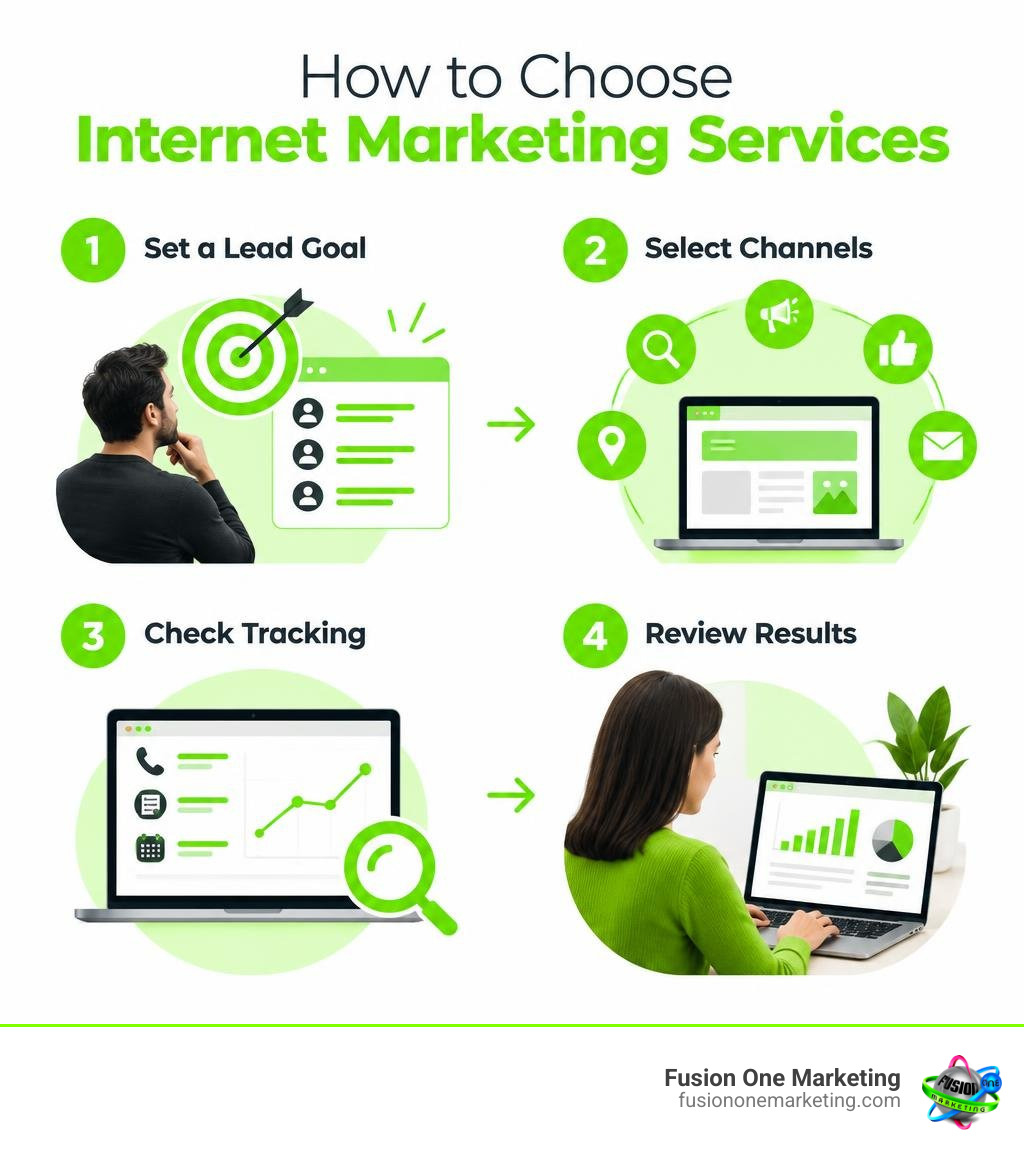
Reliable internet marketing services help the right customers find your business and make it easy for them to contact you. For a home-services company, start with a clear website and local search presence. Then consider paid search and social media based on where your customers look for help. When choosing a provider, ask how they will track calls, form submissions, and booked jobs, not just clicks.
A good plan connects those channels to one goal: more qualified leads you can turn into work. It should also show you what is working and where your budget goes.
I’m Rob Humm, an owner of Fusion One Marketing. I’ve worked in internet marketing services since 2011, with a focus on local search, pay-per-click ads, and helping businesses stay visible as search changes.
The Evolution and Modern Scope of Digital Marketing
Marketing has come a long way from static billboards and yellow page directories. The foundation of digital outreach began back in the 1980s with database marketing, where companies started organizing customer lists digitally. As the web expanded, online marketing transformed into an interactive landscape that connects brands directly with target audiences across multiple touchpoints.
Understanding the differences between conventional advertising and digital strategies helps explain why companies have shifted their investments over the years:
| Marketing Dimension | Traditional Marketing | Digital Marketing |
|---|---|---|
| Primary Channels | Print, TV, radio, direct mail, billboards | Search engines, websites, social platforms, email, video |
| Audience Targeting | Broad geographic and demographic reach | Hyper-specific behavioral, intent-based, and local targeting |
| Measurement & ROI | Estimated impressions, delayed tracking | Real-time conversion tracking, attribution, and analytics |
| Consumer Interaction | One-way communication broadcast | Interactive, two-way direct communication |
| Cost Flexibility | Fixed upfront commitments, high entry costs | Scalable budgets with real-time spend adjustments |
While traditional channels maintain a role in broad brand awareness, modern businesses rely heavily on digital solutions because every dollar spent can be connected to real activity. For a deeper breakdown of how modern technology and AI in digital marketing continue to transform business promotion, staying informed is essential.
The Evolution of Internet Marketing Services: From Banner Ads to AI
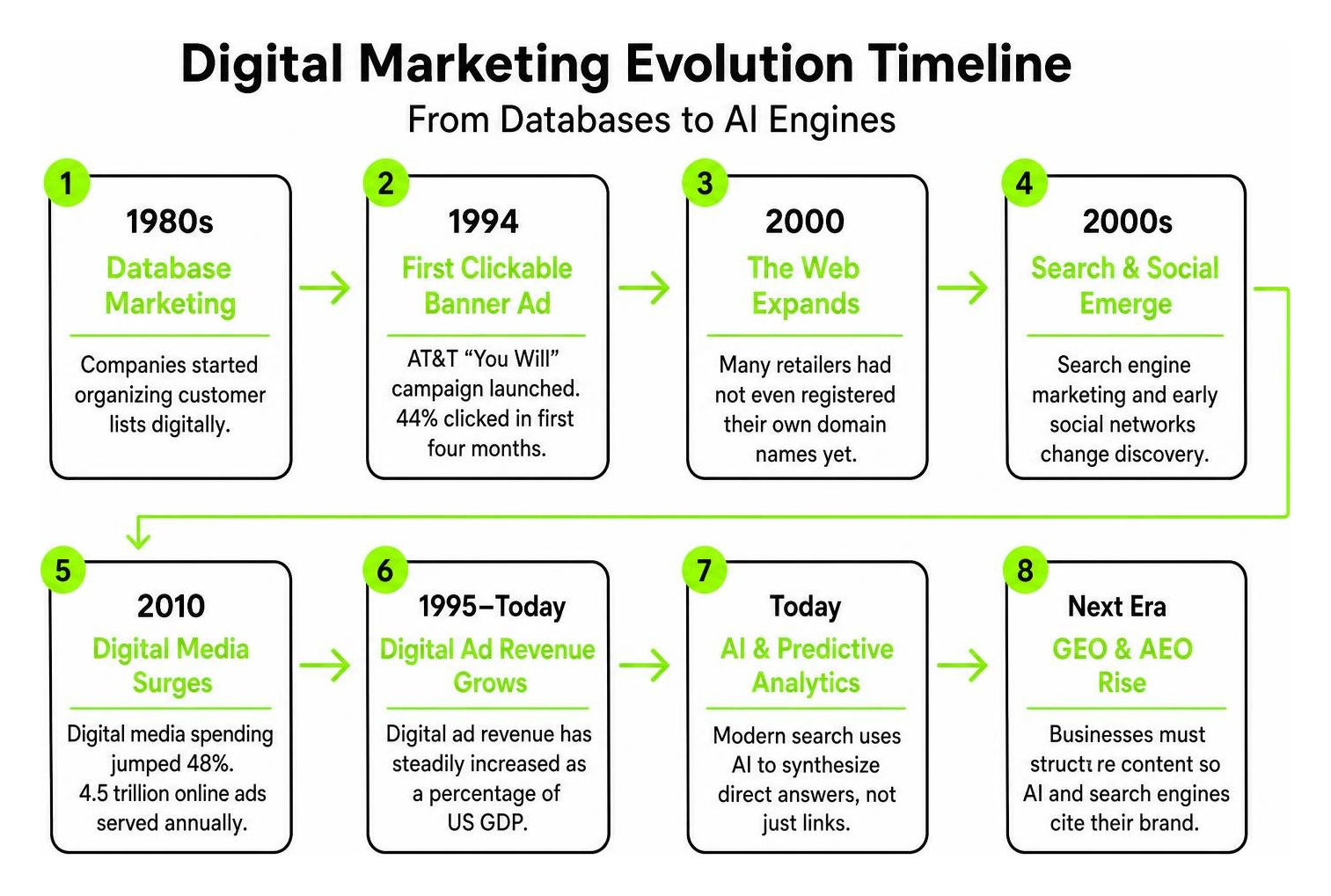
The digital advertising industry took off in 1994 when AT&T ran its famous “You Will” campaign—the world’s first clickable banner ad. Remarkably, about 44% of people who saw that ad clicked on it during its first four months. By the year 2000, many retailers had not even registered their own domain names yet. Fast-forward to 2010, and digital media spending jumped by 48% in a single year, with an estimated 4.5 trillion online ads served annually worldwide. Since 1995, digital ad revenue has steadily increased as a percentage of US GDP, capturing market share once dominated by print media.
Reviewing historical marketing trends reveals how rapid this transformation has been. In the 2000s, search engine marketing and early social networks changed how people discovered information. Today, we are witnessing another major shift with Generative Engine Optimization (GEO) and Answer Engine Optimization (AEO). Modern search engines use artificial intelligence and predictive analytics to synthesize direct answers rather than just presenting a list of links. Businesses must now ensure their content is structured so large language models and search engines cite their brand as the authoritative answer.
The Role of the Sharing Economy and Modern Consumer Channels
The rise of the sharing economy and decentralized peer-to-peer platforms has fundamentally reshaped how buyers evaluate service providers. Consumers no longer rely solely on what a company says about itself; they consult community reviews, shared experiences, and social proof across collaborative networks.
This environment demands total brand transparency. When a homeowner needs an emergency repair, they look for real customer feedback, authenticated reviews, and active local engagement. Internet marketing strategies must integrate reputation management and community engagement into their core setup.
Core Internet Marketing Services Every Growing Business Needs
Navigating the various online options can feel overwhelming, but mastering digital marketing fundamentals boils down to aligning proven channels with your sales goals.

Search Engine Optimization and Paid Advertising Channels
Search engines are the primary place high-intent customers go when they need solutions right away. A well-rounded search strategy balances organic visibility with paid advertising:
- Organic SEO: Optimizing your website architecture, content, and backlink profile helps your business earn top placements in organic search results.
- Local SEO: Crucial for home service providers and brick-and-mortar operations, local optimization puts your business in the Google Map Pack when nearby clients search for help. Tailored strategies, such as services for local contractors, help trade businesses capture high-value calls.
- Pay-Per-Click (PPC) Advertising: Google Ads and search campaigns place your brand at the very top of search queries instantly, letting you capture immediate demand while organic rankings build.
- Display and Video Networks: Visual advertisements placed across relevant websites and platforms like YouTube build familiarity. Ensuring ad-congruity—where the message of the video ad aligns tightly with the landing page—greatly improves memorability and conversion rates.
For companies operating in specific communities, running focused campaigns like Local Digital Marketing in Helena, Alabama ensures marketing budgets target the exact neighborhoods where service calls happen.
Specialized Marketing Channels for Direct Engagement
Beyond search engines, direct-to-consumer channels nurture relationships and keep your pipeline full:
- Social Media Marketing: Platforms like Facebook, Instagram, and LinkedIn allow for two-way communication, humanizing your team and building organic community trust.
- Email and SMS Marketing: Modern automation allows you to trigger personalized messages based on customer actions. For instance, early email campaigns proved that concise, visual messaging drives higher conversions, a rule that holds true today for text and email reminders.
- Push Notifications: Automated mobile and desktop notifications help re-engage visitors who visited your website but did not complete a booking.
- Affiliate and Partner Marketing: Collaborating with non-competing local partners expands your reach, though campaigns require clear tracking to protect your brand standards.
Using the right set of essential marketing tools allows your business to automate these touchpoints without losing the personal touch.
Developing a High-Impact Strategy and Navigating Challenges
Executing marketing without a unified strategy is like building a house without a blueprint. Understanding what digital marketing can do for your business starts with adopting a clear framework: Opportunity, Strategy, and Action (OSA).

Begin by analyzing market opportunity, setting SMART objectives (Specific, Measurable, Achievable, Relevant, and Time-bound), and balancing your marketing mix across paid, owned, and earned media.
Overcoming Ad Fraud and Regulatory Compliance
Digital marketers must operate within evolving privacy and regulatory frameworks. Regulations such as the General Data Protection Regulation (GDPR) and the Digital Services Act have established strict rules for user consent, tracking, and ad delivery transparency.
At the same time, the phase-out of third-party cookies means businesses must prioritize first-party data collection—such as direct email lists and customer service histories. Additionally, combating click fraud and invalid traffic requires active monitoring tools to verify that your ad spend targets genuine potential customers rather than automated bots.
Separating Industry Reality from Common Misconceptions
It is easy to get caught up in flashy metrics that do not generate revenue. Reviewing common digital marketing myths helps focus your resources on what truly moves the needle:
- Myth 1: Website traffic is the only metric that matters. Reality: Ten thousand visitors who leave immediately produce zero revenue. Ten qualified local visitors who pick up the phone can sustain your business for weeks.
- Myth 2: Social media alone will solve all customer acquisition needs. Reality: Social channels nurture brand affinity, but search channels capture consumers at the exact moment they need immediate repairs or services.
- Myth 3: Marketing automation runs entirely hands-off. Reality: Automation handles repetitive delivery tasks, but strategy, customer segmentation, and creative messaging require ongoing refinement.
How to Evaluate and Choose a Reliable Agency
Partnering with an agency should make your operations simpler, not more confusing. If you are uncertain about how your current assets are performing, scheduling a comprehensive digital marketing audit is a great first step to identify missed opportunities and technical bottlenecks.
Key Questions to Ask Providers of Internet Marketing Services
When vetting potential marketing partners, ask these direct questions during your discovery conversations:
- How do you track and attribute leads? Ensure they track phone calls, form completions, and booking confirmations down to the specific campaign source.
- What does your reporting structure look like? Look for clear monthly reporting that explains metrics in plain language instead of burying data under confusing industry jargon.
- Who owns the marketing assets and ad accounts? Your business should always maintain complete ownership of your domain, website, ad accounts, and analytics properties.
- How frequently will we communicate? Establish regular review cadences so you always know what campaigns are active and what tests are being run.
Proactive Discovery Methods to Identify Qualified Partners
Finding the right provider does not have to be a guessing game. Business owners can use targeted methods to evaluate prospective agencies:
- Review Case Studies and Local Proof: Look for agencies that have demonstrated success in service-based industries with clear, verifiable examples of lead growth.
- Examine Search Footprints: Search for how well the agency ranks for their own services across regional markets like Birmingham, Huntsville, and Helena. If they cannot achieve search visibility for themselves, ranking your business will prove difficult.
- Assess Strategic Proposals: Beware of one-size-fits-all packages. A reliable agency reviews your local market conditions, inspects your existing web footprint, and crafts a customized strategy tailored to your specific business capacity.
Frequently Asked Questions About Internet Marketing
For additional insights, browse our answers to frequently asked questions below:
What is the difference between digital marketing and online marketing?
While frequently used interchangeably, their scopes differ slightly. Online marketing refers specifically to channels that require an active internet connection, such as websites, search engines, and social media networks. Digital marketing is an umbrella term that includes online marketing as well as non-internet digital media, such as direct SMS messaging, digital billboards, and interactive digital displays.
How long does it take to see a measurable ROI from campaigns?
The timeline depends on the channels deployed:
- PPC Advertising: Can generate qualified phone calls and leads within days of campaign launch.
- Local SEO & Organic Search: Typically requires three to six months to build authority, climb rankings, and show substantial compounding returns.
- Content & Brand Marketing: Gains momentum over six to twelve months as authoritative resources accumulate traffic and backlinks.
A balanced strategy couples immediate PPC lead generation with long-term organic SEO growth.
Why is Generative Engine Optimization crucial in 2026?
As AI-powered search engines provide direct summaries to user questions, appearing in traditional search results alone is no longer sufficient. Generative Engine Optimization ensures your content is organized, semantically rich, and authoritative enough that AI answer engines extract and recommend your company when searchers ask for recommendations.
Conclusion
Building a sustainable flow of qualified leads requires more than isolated tactics; it requires an integrated strategy where your website, organic search, paid advertising, and direct engagement channels work together seamlessly.
At Fusion One Marketing, we help businesses eliminate guesswork through our integrated Digital Domination program, combining custom web design, proven local SEO, targeted PPC, and active social media management into one unified growth engine. Ready to take control of your local market? Reach out to scale your business online today and let us build a predictable pipeline of qualified leads for your team.