

Why HVAC Google Ads Are the Fastest Path to More Service Calls
HVAC Google Ads put your business in front of homeowners at the exact moment their system breaks down — and that moment is worth a lot.
Here’s a quick look at what works and what to expect:
| What You Want to Know | Quick Answer |
|---|---|
| Best campaign types | Emergency repair, system replacement, maintenance — run separately |
| Average cost per lead | $104 blended; $34 branded, $149 non-branded, $72 Performance Max |
| Minimum monthly budget | $2,000–$3,000 for a mid-size market |
| Top-converting keywords | “AC repair near me,” “emergency furnace repair,” “HVAC replacement near me” |
| Most important metric | Book rate, not just cost per lead |
| LSAs vs. Search Ads | LSAs appear above Search Ads and charge per lead, not per click |
| Biggest mistake | Sending all traffic to your homepage instead of a service-specific landing page |
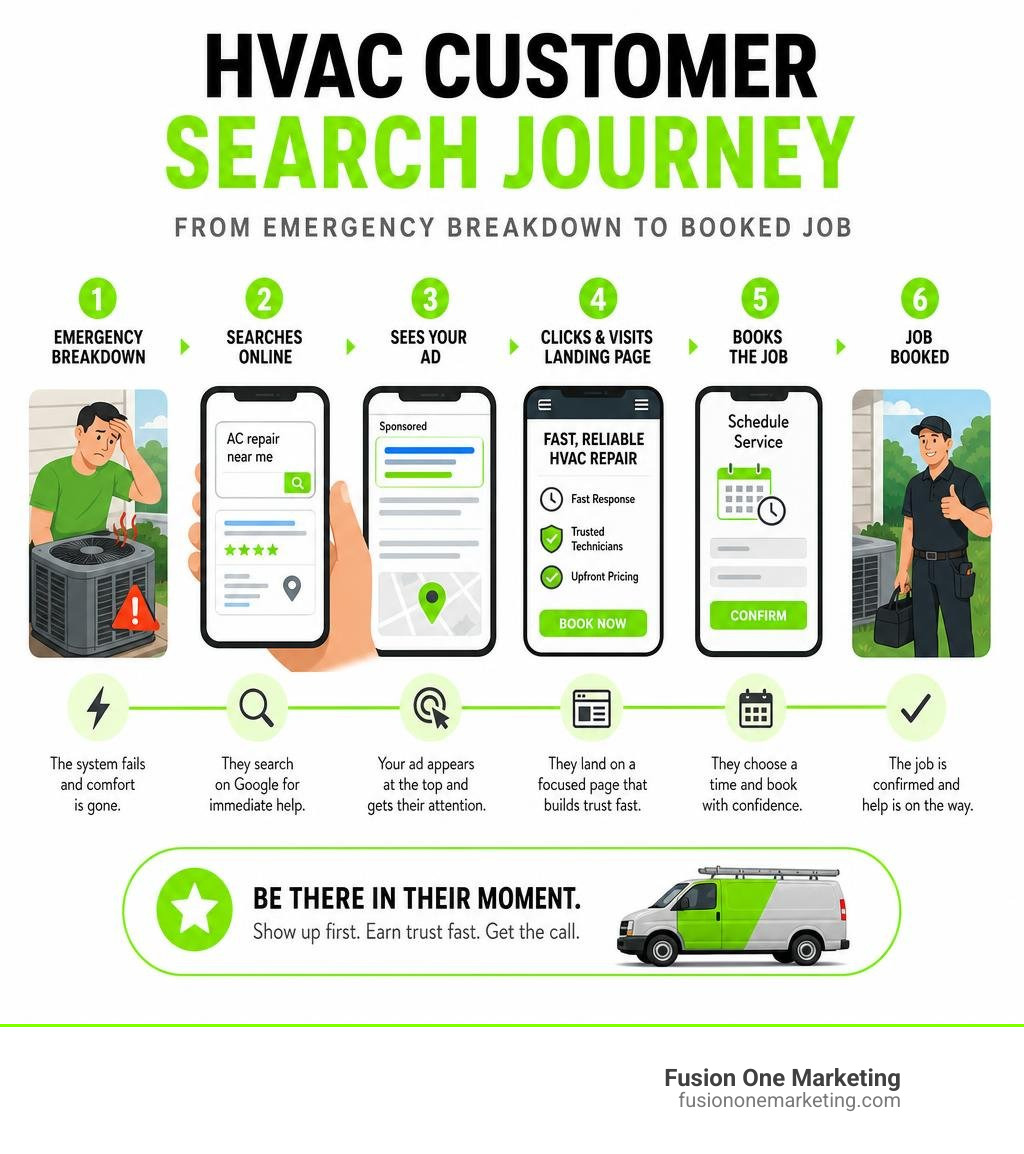
It’s 97 degrees outside. A homeowner’s AC just died. They grab their phone, type “AC repair near me,” and call the first result that looks trustworthy. That’s your window — and it lasts about 30 seconds.
The challenge is that HVAC is one of the most competitive niches in Google Ads. Search volume for AC repair alone spikes 266% in July. Emergency keywords can cost $22–$45 per click. And if your campaigns aren’t structured correctly, you can burn through your entire budget on DIY researchers, job seekers, and people outside your service area.
The good news? A single new HVAC customer is worth an average of $15,340 in lifetime value. That means even a $150 cost per lead can be an incredible deal — if your campaigns, landing pages, and follow-up are built to convert.
This guide walks you through exactly how to set that up.
How to Structure Your HVAC Google Ads Campaigns for Maximum ROI
One of the most expensive mistakes we see local contractors make is dumping every service they offer into a single campaign. When you lump emergency repairs, system replacements, and routine duct cleanings under one budget, Google’s algorithm struggles to optimize your bids. The result is a messy account that drains your cash and delivers low-quality leads.
To get the most out of your ad spend, you need a structured account built around customer intent.

If you are new to setting up your account, watching a video tutorial on HVAC campaign setup can give you a visual walkthrough of the platform. However, to turn those clicks into paying customers, you must follow the principles of How to Run a Successful Google Ads Campaign to build a solid foundation.
Segmenting Campaigns by Service Type and Intent
To make your HVAC Google Ads profitable, you must split your campaigns by service line and buyer intent. Homeowners looking for a quick fix have a completely different mindset than those researching a five-figure heat pump replacement.
We recommend building four distinct campaigns:
- Emergency Repair: This campaign targets high-urgency keywords like “AC not cooling” or “emergency furnace repair.” It requires a “Maximize Conversions” bidding strategy to capture the immediate demand. The decision cycle here is minutes, not days.
- System Replacement / Installation: This campaign targets high-ticket, research-driven keywords like “new HVAC system cost” or “heat pump installation.” Because these leads take longer to convert, we use a “Target CPA” (Cost Per Acquisition) bidding strategy and lead with financing offers.
- Preventative Maintenance / Tune-Ups: This is your baseline campaign for low-cost keywords like “AC tune-up special” or “furnace inspection.” It is highly visual, offer-driven, and keeps your schedule full during the slower months.
- Branded Search: This campaign bids on your own business name. It is highly affordable (often under $35 per lead) and prevents competitors from stealing your loyal customers at the top of the search page.
By segmenting your campaigns this way, you can read our Beginners Guide to Search Ads to understand how matching the right message to the right search intent directly lowers your overall costs.
Traditional Search vs. Performance Max for HVAC Companies
As we navigate 2026, Google’s automated campaign type, Performance Max (PMax), has become highly popular. Performance Max uses AI to run ads across Search, YouTube, Display, and Gmail. But is it right for your local HVAC business?
The data shows a fascinating split. Performance Max campaigns boast a lower average cost per lead ($72) compared to traditional non-branded search campaigns ($149). However, PMax leads typically have a lower book rate (32.2%) compared to traditional search (37.6%).
The reason? Performance Max often chases cheaper, lower-intent placements, such as showing display ads to DIYers watching YouTube videos on how to fix their own AC.
For emergency repair services, traditional search campaigns remain the undisputed king because they target exact-match search terms with high intent. However, PMax can be a fantastic tool for driving replacement leads and brand awareness when paired with strong visual assets and strict audience signals.
To stay ahead of these algorithmic shifts, you can check out the latest Google Ad Trends That Will Put You On Top to see how to balance machine learning with manual control.
High-Converting Keyword Strategies and Negative Keyword Discipline
Keywords are the lifeblood of your search marketing. If you target terms that are too broad, you will pay for clicks from people who have no intention of hiring you. If you target terms that are too narrow, your phone won’t ring.

To prevent your budget from vanishing, you need a balanced keyword strategy and a strict negative keyword list. We highly recommend reviewing our Google Ads Checklist to make sure your targeting settings are completely optimized before launching.
Selecting the Best Keywords for HVAC Google Ads
The best keywords for hvac google ads are transactional, meaning they indicate a readiness to buy.
- Bad (Informational): “how to fix AC leak,” “why is furnace blowing cold air,” “average cost of central air.”
- Good (Transactional/High-Intent): “emergency AC repair near me,” “licensed HVAC contractor Birmingham,” “heat pump installation Helena AL.”
Notice the use of geo-modifiers. Adding specific city names to your keywords helps you win local auctions and speaks directly to the searcher’s location. Additionally, focusing on long-tail keywords (queries containing three or more words) lowers your cost per click (CPC) because there is less competition.
For example, bidding on “AC repair” in a competitive metro area like Huntsville can cost upwards of $75 per click. However, bidding on “24 hour emergency AC repair Huntsville” targets a highly motivated buyer and often costs significantly less.
Understanding these nuances is key to unlocking the true Benefits of Paid Per Click Advertising for your home service business.
Building a Bulletproof Negative Keyword List
While finding the right keywords gets you noticed, negative keywords are what keep you profitable. Negative keywords tell Google not to show your ads when certain terms are included in a user’s search.
Without a robust negative keyword list, you will waste 20% to 30% of your budget on completely irrelevant clicks. We recommend building a master negative list containing at least 500 terms across these major categories:
- DIY and Parts: “how to,” “parts,” “compressor replacement DIY,” “manual,” “schematics,” “diagram,” “wholesale.”
- Employment and Education: “jobs,” “careers,” “salary,” “classes,” “training,” “school,” “certification.”
- Cheap/Free: “free,” “cheap,” “used,” “rent,” “salvage.”
- Competitors: If you do not want to bid on competitor names, exclude all local competitors in your service area.
Perform weekly search term audits in your Google Ads account to catch any unwanted queries and immediately add them to your negative keyword list.
Budgeting, Seasonality, and Realistic Cost Per Lead Benchmarks
Understanding your numbers is the difference between a campaign that scales your business and one that drains your bank account. Let’s look at the actual 2026 benchmarks for HVAC search campaigns:
| Campaign Type | Avg. Cost Per Click (CPC) | Avg. Cost Per Lead (CPL) | Avg. Book Rate | Avg. Ticket Value |
|---|---|---|---|---|
| Branded Search | $2.00 – $4.00 | $34 | 55.3% | $500 – $1,500 |
| Emergency Repair | $22.00 – $45.00 | $149 | 37.6% | $350 – $800 |
| System Replacement | $35.00 – $75.00 | $220 – $340 | 24.2% | $5,000 – $18,000 |
| Maintenance / Tune-Up | $10.00 – $22.00 | $50 – $75 | 45.0% | $80 – $150 |
To see how these numbers fit into your broader digital marketing strategy, explore our dedicated services for Pay Per Click.
Determining Your Monthly Budget and Seasonality Adjustments
To generate meaningful results, you must invest enough to feed Google’s machine-learning algorithm. In a mid-size market, a starting budget of $2,000 to $3,000 per month for Google Search is the baseline needed to gather data and book jobs. For larger competitive metros, a budget of $5,000 to $10,000+ is required to dominate the market.
However, HVAC demand is heavily weather-dependent. In Alabama, our summers are scorching and our winters bring sharp cold snaps. Your budget must flex with these seasonal swings.
Never fully pause your campaigns during the mild “shoulder seasons” of spring and fall. Pausing your ads completely destroys your campaign history and forces Google’s algorithm to restart its learning phase when peak season returns. Instead, scale your budget down to a baseline level (50% to 60% of peak spend) and shift your messaging to preventative maintenance specials, system tune-ups, and indoor air quality (IAQ) upgrades.
Understanding Cost Per Lead and ROI Metrics in HVAC Google Ads
Many business owners focus solely on lowering their Cost Per Lead (CPL). But CPL is a vanity metric if those leads don’t turn into booked jobs. To measure true success, you must track your entire sales funnel:
- Book Rate: The percentage of leads that turn into a booked appointment. (A lead that doesn’t book is worthless).
- Match Rate: The percentage of booked appointments where a technician actually runs the call.
- Close Rate: The percentage of ran calls that result in a sale.
- Customer Acquisition Cost (CAC): Total ad spend divided by paying customers.
For example, if you spend $1,000 on ads and get 10 leads, your CPL is $100. If your CSRs book 4 of those leads into appointments, and your technicians close 2 of them, your CAC is $500. If those two jobs are system replacements worth $10,000 each, you spent $1,000 to make $20,000 in revenue. That is a 20:1 return on investment!
Integrating Local Services Ads (LSAs) and the Google Guarantee
Sitting at the absolute top of the Google search results page — even above traditional search ads — are Google Local Services Ads (LSAs).
LSAs are a game-changer for local home service businesses because they operate on a pay-per-lead model rather than pay-per-click. This means you only pay when a customer calls or messages you directly through the ad. For more detailed setup instructions, you can read the official Google Local Services Ads Guide.
How LSAs and the Google Guarantee Drive High-Value Leads
The key feature of LSAs is the green Google Guaranteed badge. This badge serves as a massive trust signal for skeptical homeowners. It tells them that Google has vetted your business, verified your licenses and insurance, and passed background checks on your technicians. If a customer is unhappy with your work, Google may reimburse them up to $2,000.
To maximize your LSA rankings and drive more high-value leads:
- Upload Authentic Video: Google’s algorithm favors profiles that feature an authentic, 15-second video introduction of your team. This simple addition can boost your profile’s conversion rate by up to 20%.
- Stack High-Star Reviews: Your Google Business Profile review rating and volume directly impact your LSA visibility. Consistently ask happy customers for reviews.
- Maintain Fast Response Times: If you let LSA calls go to voicemail or respond slowly to messages, Google will quickly lower your ad rankings.
Landing Page and Ad Copy Tweaks That Double Your Conversion Rate
You can have the most beautifully optimized Google Ads campaign in the world, but if you send that high-intent traffic to a slow, confusing website, you are throwing your money away.
Your website and landing pages are half of the conversion equation. By raising your landing page conversion rate from 10% to 20%, you instantly cut your cost per lead in half without spending an extra dime on ads.
Designing Mobile-First Landing Pages That Convert Clicks to Calls
Over 76% of all HVAC searches happen on mobile devices. When a homeowner’s furnace dies in the middle of a freezing January night, they aren’t opening a laptop — they are searching on their phone. Your landing pages must be built mobile-first.
- Ditch the Homepage: Never send paid traffic to your homepage. If a user clicks an ad for “furnace repair,” they should land on a page dedicated exclusively to furnace repair, not a generic page talking about your company history.
- Remove Navigation Menus: Remove the main header menu from your landing pages. You want to keep the user focused on a single action: calling you or filling out a form. Don’t let them wander off to read your blog.
- Sticky Click-to-Call Button: Place a large, bold, clickable phone number at the very top of the mobile screen that stays anchored as the user scrolls.
- Page Speed is Critical: A landing page that takes longer than 3 seconds to load will lose half of its traffic. Optimize your images and clean up your code to ensure lightning-fast load times.
- Use Real Photos: Ditch the cheesy stock photos of pristine models holding wrenches. Use real photos of your wrapped trucks, your local office, and your actual technicians in uniform. Authenticity builds immediate trust.
Writing Compelling Ad Copy and Leveraging Ad Extensions
Your ad copy must match the searcher’s urgency and emotional state.
For emergency campaigns, focus on speed, availability, and relief:
- Headline 1: Emergency AC Repair Helena
- Headline 2: 24/7 Fast Repair – Call Now
- Headline 3: $50 Off Same-Day Service
- Description: AC stopped working? Don’t sweat it! Our licensed technicians are standby 24/7. Fast response times, upfront pricing, and 100% satisfaction guaranteed.
For system replacements, focus on credibility, affordability, and financing:
- Headline 1: High-Efficiency AC Install
- Headline 2: Financing As Low As $89/Mo
- Headline 3: Get A Free In-Home Estimate
- Description: Upgrade to a new, energy-saving system today. No money down, low monthly payments, and a 10-year parts warranty. Call for your free quote!
Always take advantage of every available ad extension (now called assets). Use callout assets to highlight your selling points (“NATE-Certified,” “Licensed & Insured,” “Since 1998”), and use sitelink assets to direct users to financing options or customer reviews.
Frequently Asked Questions About HVAC Search Marketing
What is a realistic cost per lead for HVAC campaigns?
A realistic blended cost per lead (CPL) for HVAC Google Ads in 2026 is $104. However, this varies wildly by campaign type. Branded search campaigns deliver the cheapest leads at around $34. Performance Max campaigns average $72 per lead, while highly competitive, non-branded search campaigns (like emergency repairs) average $149 per lead due to the high purchase intent and intense bidding wars in local markets.
How do I prevent my budget from being wasted on DIY searches?
The most effective way to block DIY searches is through strict negative keyword lists and exact match targeting. Regularly review your search term reports to see the actual queries triggering your ads. If you spot terms like “how to clean AC coils” or “furnace parts diagram,” add “how to,” “clean,” “coils,” “parts,” and “diagram” as negative keywords to keep your budget focused on paying customers.
Should I pause my Google Ads during the shoulder seasons?
No, you should never fully pause your campaigns. Pausing your ads completely resets Google’s machine learning, meaning your campaigns will have to go through an expensive “re-learning” phase when peak season returns. Instead, lower your budget by 40% to 50% during the mild spring and fall months, and shift your ad copy to promote preventative maintenance specials, system tune-ups, and indoor air quality upgrades.
Dominate Your Local Market with Fusion One Marketing
Running profitable hvac google ads campaigns requires constant monitoring, deep technical expertise, and a highly optimized website. You didn’t get into the heating and cooling business to spend your nights analyzing keyword Quality Scores and bidding algorithms.
That is where we come in.
At Fusion One Marketing, we specialize in helping home service businesses grow. Our signature “Digital Domination” program is an all-in-one marketing solution designed to handle your SEO, website design, social media, and paid search marketing. We align your digital presence so that every click has the highest chance of turning into a booked job.
Whether you are based in Birmingham, AL, Huntsville, AL, Helena, AL, or anywhere across Alabama, we know your local market, we know your climate, and we know exactly what makes local homeowners call.
Ready to stop wasting your ad budget and start scaling your schedule? Contact us today to learn more about our Fusion One Marketing Services and let’s get your phones ringing!