
Your Customers Are Already Searching on Google — Are You Showing Up?
Google Ads is an online advertising platform that lets businesses pay to show ads on Google Search, YouTube, Google Maps, and other Google properties. You only pay when someone clicks your ad.
Here’s how Google Ads works in simple terms:
- You choose keywords — the search terms you want to trigger your ads
- You set a budget — a daily or monthly cap on what you’ll spend
- Google runs an auction — every time someone searches, Google picks which ads to show based on your bid and ad quality
- You pay per click — your ad appears, and you’re charged only when someone clicks it
- Visitors land on your page — where they can call, fill out a form, or buy
If you run a home services business — plumbing, HVAC, electrical, landscaping — your next customer is probably searching Google right now. And if your business isn’t showing up, a competitor is getting that call instead.
The good news? You don’t need a massive budget or a marketing degree to get started. This guide walks you through everything: how the platform works, which campaign type fits your goals, how to manage costs, and how to get real leads from your first campaign.
Understanding the Platform and How It Works
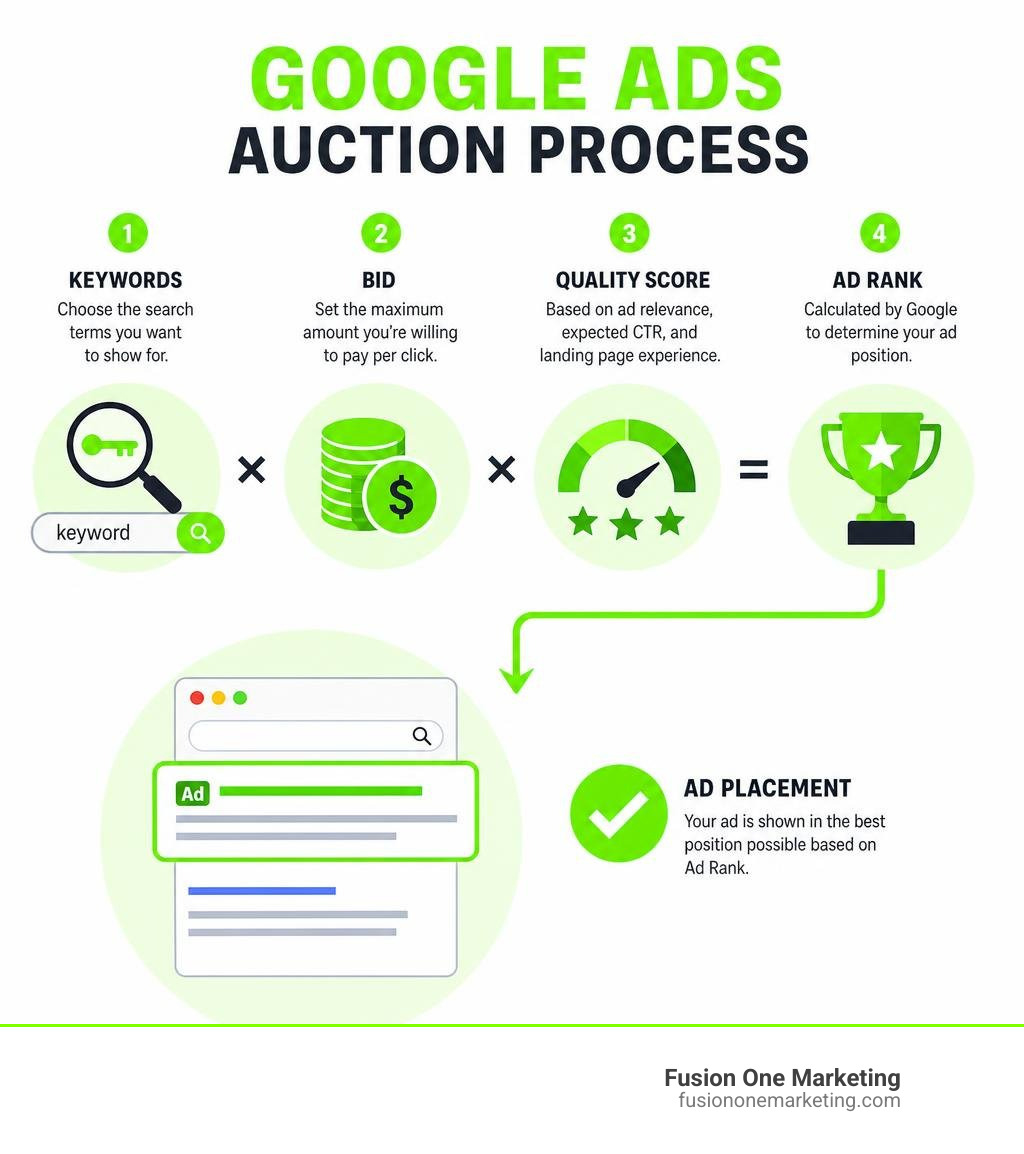
To win at Google Ads, you have to understand the rules of the game. Many business owners think that the advertiser with the deepest pockets always gets the top spot. Fortunately, that is not how Google operates. The platform relies on a highly sophisticated, real-time auction system designed to reward relevance and quality just as much as budget.

Every time a user types a query into Google, an instantaneous ad auction occurs. Google looks at all advertisers bidding on the keywords matching that query and determines which ads to display, in what order, and at what cost. This decision is based on two primary factors:
- Your Bid: The maximum amount you are willing to pay for a click on your ad.
- Your Quality Score: A rating from 1 to 10 that Google assigns to your ad based on its relevance to the search query, the expected click-through rate (CTR), and the quality of your landing page.
By multiplying your maximum bid by your Quality Score, Google calculates your Ad Rank. The advertiser with the highest Ad Rank gets the coveted top position.
This means a local service provider in Helena, AL with an optimized, highly relevant landing page and a great Quality Score can easily outrank a massive national brand bidding twice as much but delivering a poor user experience. Understanding these mechanics is the first step toward unlocking the benefits of paid per click advertising without draining your marketing budget.
How Google Ads Generates Leads and Sales
For local businesses throughout Alabama, from the bustling neighborhoods of Birmingham to the growing tech communities in Huntsville, Google Ads is the ultimate tool for capturing high-intent traffic.
Consider this: 97% of people learn more about a local company online than anywhere else. When someone’s water heater bursts or their air conditioning fails in the middle of a sweltering Southern summer, they do not browse social media looking for recommendations; they search Google for immediate help.
By targeting high-intent keywords like “emergency AC repair Birmingham” or “clogged drain plumber Huntsville AL,” you position your business directly in front of active buyers at the exact moment they need your services. This is why PPC is unmatched for rapid lead generation.
Additionally, because 99.9% of consumers read reviews before making a purchase online, integrating your stellar reputation with local search campaigns makes your business the obvious choice.
By utilizing conversion tracking, you can trace every single dollar of ad spend back to a specific phone call, form submission, or booking. This level of transparency ensures you are never guessing whether your marketing is working. To dive deeper into this process, check out our detailed guide on how Google Ads can help you get more qualified leads.
Choosing the Right Google Ads Campaign Types
Google offers several campaign types, each tailored to different business goals and target audiences. To get the best results, you must align your campaign type with your specific marketing objectives.
| Campaign Type | Primary Goal | Where It Appears | Best For |
|---|---|---|---|
| Search | High-intent lead generation & sales | Google Search results, Google Maps | Service businesses, emergency repairs, local services |
| Performance Max | Multi-channel conversion optimization | Search, YouTube, Display, Discover, Maps, Gmail | E-commerce, automated local lead generation |
| Display | Brand awareness & remarketing | Over 3 million partner websites and apps | Staying top-of-mind, visually showcasing products |
| Shopping | Retail and e-commerce sales | Google Shopping tab, Search results | Direct online product sales |
| Demand Gen | Visual discovery & engagement | YouTube, Shorts, Discover, Gmail | Visual storytelling, driving early-stage interest |
Choosing the right campaign type is the foundation of your success. If you want to dive deeper into how Google structures these options to help businesses grow, you can explore the official Advertising Solutions for Your Marketing Goals – Google Ads resource. Once you have a clear goal in mind, you can utilize the main Reach Customers & Sell More with Online Advertising – Google Ads portal to begin setting up your campaigns.
Search and Responsive Search Ads
Search ads are the bread and butter of local digital marketing. When you use a search campaign, you primarily rely on Responsive Search Ads (RSAs). Instead of writing static ads, RSAs allow you to input up to 15 headlines and 4 descriptions. Google’s machine learning then automatically tests different combinations to see which performance matches the searcher’s intent best.

Maximizing the effectiveness of your RSAs requires paying close attention to your “Ad Strength” rating. The statistics speak for themselves: advertisers who improve Ad Strength for their responsive search ads from ‘Poor’ to ‘Excellent’ find 15% more clicks and conversions on average.
Furthermore, the structure of your ad groups matters. Our data shows that advertisers with one RSA who add an additional RSA to their ad group (for a total of 2 RSAs) find a 6.6% increase in conversions at a similar cost per conversion on average. If you take it a step further, advertisers with 2 RSAs who add an additional RSA to their ad group (for a total of 3 RSAs) find an average 3.7% increase in conversions.
To make sure your search ads perform beautifully, you should follow the official guidelines on About responsive search ads – Google Ads Help. If you are completely new to this ad format, our beginner’s guide to search ads will give you a step-by-step roadmap to writing copy that converts.
Performance Max and Demand Gen
If you want to cast a wider net using the power of artificial intelligence, Google’s Performance Max (PMax) and Demand Gen campaigns are the way to go.
Performance Max is an all-in-one campaign type that uses Google’s advanced AI to serve your ads across the entire Google network—Search, Display, YouTube, Discover, Maps, and Gmail—from a single campaign setup. It continuously analyzes real-time signals to predict buyer readiness and automatically allocates your budget to the channels performing the best.
Demand Gen campaigns, on the other hand, focus heavily on visually immersive creatives. By leveraging YouTube, Shorts, and Discover feeds, Demand Gen helps you build brand awareness and drive engagement before a user even performs a search. Both of these campaign types rely heavily on automated assets and machine learning to optimize your return on investment. To understand the technology behind these automated systems, read our comprehensive breakdown of Google Ads AI.
Maximizing ROI: Smart Bidding and Best Practices
To get the most out of your budget in June 2026, you cannot rely on manual bid adjustments. The modern landscape of digital advertising belongs to automated bidding.
Today, more than 80% of Google advertisers are using automated bidding to manage their campaigns. Google’s AI-powered Smart Bidding analyzes billions of signal combinations—including the user’s device, browser, language, location, and time of day—to set the perfect bid for every single auction.
When setting up your bidding strategy, you have several options depending on your goals:
- Target CPA (Cost Per Acquisition): Focuses on getting as many conversions as possible at your target cost.
- Target ROAS (Return on Ad Spend): Focuses on maximizing conversion value based on the revenue generated.
Transitioning between these strategies can yield massive rewards. Indeed, advertisers that switch from a Target CPA to a Target ROAS bid strategy can see 14% more conversion value at a similar return on ad spend. To learn more about setting up these advanced bidding algorithms, explore the official guide on AI-powered Smart Bidding and Bid Optimisations – Google Ads.
Integrating Google Ads with Analytics and Tag Manager
You cannot optimize what you do not measure. To feed Google’s AI the clean, accurate data it needs to perform, you must integrate your ad account with Google Analytics (GA4) and Google Tag Manager (GTM).
This integration allows you to track specific conversion actions, such as form fills, phone calls, or button clicks. By passing this conversion data back to your ad account, the bidding algorithms learn exactly what a high-quality lead looks like, allowing them to target similar users more effectively. Before launching any campaign, make sure you run through our essential Google Ads checklist to confirm your tracking tags are firing perfectly.
Overcoming Common Challenges and Costs
Running a successful Google Ads campaign is not without its hurdles. Many new advertisers face challenges like click fraud, rising cost-per-click (CPC) in highly competitive niches, or managing their daily ad spend without overspending.
One common complaint from new advertisers is that they spent money but did not see immediate phone calls. This usually happens when campaigns are not properly targeted, or when negative keywords are neglected, causing ads to show for irrelevant searches (like bidding on “plumbing jobs” when you want “plumbing services”).
To help new businesses get off the ground, Google often provides promotional offers and ad credits (such as matching your spend up to a certain amount within the first 60 days). However, you must complete your billing setup and meet the minimum spend requirements to unlock these credits.
When deciding where to allocate your marketing dollars, it is also highly beneficial to compare platforms. If you are debating between search intent and social media targeting, read our detailed comparison: Google Ads or Facebook Ads: Which One is Better?.
For businesses looking for local support to navigate these complexities, Alabama has a robust network of digital resources. While Google’s massive presence in the state is anchored by the Jackson County, Alabama – Google Data Center Location, local businesses often rely on regional marketing expertise to manage their campaigns. Partnering with a local agency that understands the unique demographics of our state—from Birmingham and Huntsville to Helena—ensures your campaigns remain highly targeted, cost-effective, and tailored to your specific audience.
Frequently Asked Questions About Online Advertising
How much budget do I need to start advertising?
There is no one-size-fits-all answer, but we recommend starting with a daily budget that allows for at least 5 to 10 clicks per day based on your industry’s average cost-per-click. For most local service businesses in Alabama, a starting budget of $1,000 to $1,500 per month is sufficient to gather actionable data and generate consistent leads.
How do promotional ad credits work for new accounts?
Google frequently offers spend-match promotions for new advertisers (e.g., spend $500, get $500 in ad credit). To claim this, you must enter the promotional code, complete your billing setup, and reach the required spend threshold within 60 days of creating your account.
What is the difference between SEO and PPC?
SEO (Search Engine Optimization) focuses on earning organic, free traffic by optimizing your website over time. PPC (Pay-Per-Click) is a paid strategy that buys immediate visibility at the top of search engine results. Both are essential parts of a healthy digital strategy. To see how they work together, read about the power of pay per click advertising.
Conclusion
Mastering Google Ads is one of the fastest, most reliable ways to grow your business, secure qualified leads, and dominate your local market. However, managing campaigns, optimizing bids, and keeping up with the latest Google Ad Trends That Will Put You On Top can easily become a full-time job.
At Fusion One Marketing, we specialize in taking the stress out of digital advertising. Through our signature “Digital Domination” program, we provide an all-in-one marketing solution—combining custom web design, SEO, social media, and high-performing Pay Per Click campaigns—tailored specifically for home services and local businesses in Birmingham, Huntsville, Helena, and throughout Alabama.
Ready to stop searching for customers and start selling? Let our team of experts build, manage, and optimize your campaigns for maximum return on investment.