
How to Make Ads That Turn Attention Into Leads
To make ads that convert, start with one clear customer problem, offer a simple benefit, and send every click to a page that matches the ad. For a home-service business, that usually means choosing a high-intent service, such as emergency repair or a seasonal tune-up, then building the campaign around it.
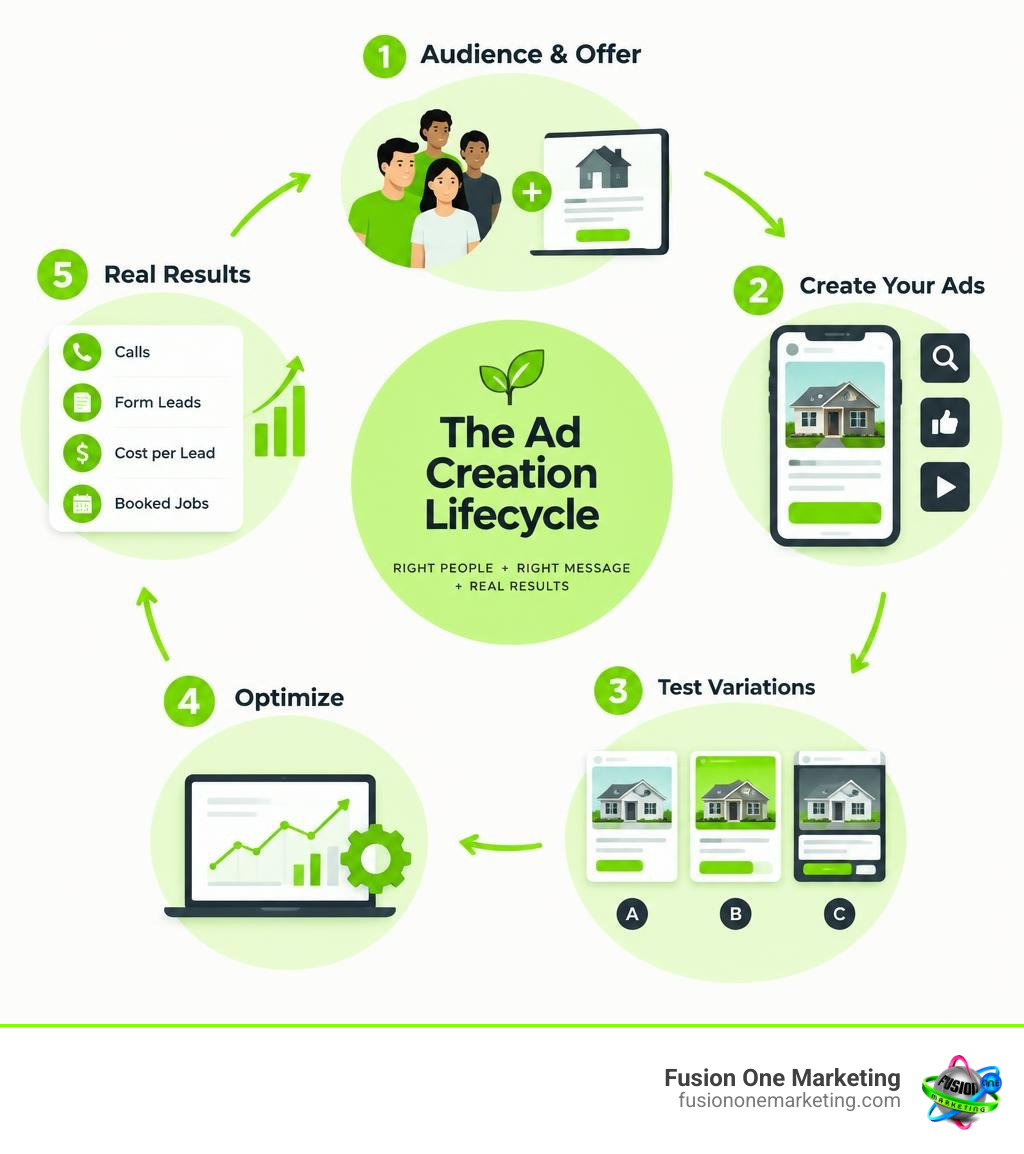
- Define who needs the service and what they want solved.
- Write a direct hook that earns attention in the first three seconds.
- Show the service, proof, and a clear next step.
- Use the right format for the platform, then test several versions.
- Track calls, form leads, cost per lead, and booked jobs – not clicks alone.
Good ads are not just attractive. They are relevant. A homeowner searching Google for a plumber needs a different message than someone scrolling through Facebook or TikTok. The ad, audience, offer, and landing page need to tell the same story.
Core Foundations: How to Make Ads for Modern Audiences
Every profitable advertising campaign begins long before you launch an ad platform or pick an image. It begins with audience empathy and clarity. When learning how to make ads, your primary goal is to isolate a specific customer problem and pair it with an undeniable value proposition.
If you run a local HVAC, plumbing, or roofing business across Alabama, broad statements like “We provide top quality service” fall flat. Consumers do not wake up wishing to purchase HVAC services; they want their air conditioning restored on an August afternoon in Birmingham, or they want an honest upfront quote without hidden dispatch fees.
To build an ad that resonates:
- Pinpoint the emotional pain trigger: Focus on inconvenience, financial uncertainty, property damage, or immediate safety concerns.
- Articulate the primary solution: Present a single, frictionless offer such as a $79 seasonal diagnostic, same-day emergency dispatch, or a zero-down financing package.
- Keep brand messaging conversational and accessible: Skip internal jargon. Speak to homeowners using the exact words they use when calling your office.
Navigating audience psychology also means avoiding aggressive or disjointed creative strategies. Following the dos and don’ts of social media advertising ensures you protect your brand reputation while maintaining high conversion efficiency across fast-scrolling feeds.
Crafting Irresistible Hooks and Creative Angles
On social and short-form video channels, you do not have thirty seconds to explain who you are. Research reveals that ads with a clear hook in the first 3 seconds see up to 80% of scroll-stop performance determined by those opening moments alone. If the initial three seconds fail to grab attention, the remaining production value is wasted.

Four proven hook formats consistently stop the scroll across modern feeds:
- Problem Call-Out: Speak directly to an active frustration. (“If your AC is blowing warm air right now, don’t pay a $150 dispatch fee before checking this.”)
- Curiosity Gap: Open an intriguing loop that requires watching the solution. (“The real reason your upstairs rooms are always 10 degrees hotter than downstairs.”)
- Contrarian Claim: Challenge common assumptions to disrupt passive scrolling. (“Why replacing your water heater might actually be a massive waste of money this year.”)
- Before/After Transformation: Highlight visual or situational proof immediately in the first frame. (“From a flooded basement at 7 AM to completely dry by noon.”)
Traditional UGC vs. AI UGC Video Production
User-Generated Content (UGC) transformed digital advertising by replacing polished, corporate studio commercials with relatable, handheld phone footage. In 2026, the emergence of photorealistic AI UGC video has introduced unprecedented speed and volume to creative production.
Understanding when to deploy traditional creator UGC versus synthetic AI UGC allows marketing budgets to stretch further while testing dozens of hooks simultaneously.
| Dimension | Traditional Creator UGC | AI UGC Video Ads |
|---|---|---|
| Production Cost | $150 – $500 per asset | $0.50 – $5 per render |
| Turnaround Time | 7 – 21 business days | 10 – 30 minutes |
| Iterative Testing Volume | Low (script changes require reshoots) | High (render dozens of hook variations instantly) |
| Authenticity Factor | High lived-experience realism | High visual fidelity; requires careful avatar matching |
| Best Use Case | Evergreen cornerstone assets, deep brand advocacy | Rapid multi-hook testing, high-velocity creative testing |
AI UGC ads are not a complete replacement for human storytelling; rather, they serve as a high-volume testing layer. Brands can test 20 AI hook concepts for the cost of a single dinner, identify the winning angle, and either scale the AI asset directly or commission a human creator to film the validated script.
Designing High-Performing Creative Assets and Formats
A great script will fail if it is formatted incorrectly for the user’s screen or context. Creating modern video ads requires building natively for multi-platform distribution. Follow modern technical standards outlined in the How to Create AI UGC Video Ads (2026 Guide) to ensure your creative looks authentic in every placement.
- Vertical (9:16): Built for TikTok, Instagram Reels, Facebook Reels, and YouTube Shorts. Keep vital text overlays and faces within the center safety zone to prevent interface icons from blocking your message.
- Square (1:1): Ideal for Meta desktop and mobile feed placements where vertical video gets cropped.
- Horizontal (16:9): Reserved for YouTube in-stream pre-roll and desktop-first landing page embeds.
- Auto-Captions: Approximately 80% of social video is consumed with the sound muted. Large, stylized dynamic captions are required to communicate the hook, value offer, and call to action visually.
Step-by-Step: How to Make Ads with AI UGC and Video
Executing a high-performing video ad follows a structured production workflow that balances pacing with visual clarity.

- Avatar and Voice Selection: Select a photorealistic avatar that matches the target demographic of your audience. An avatar representing a 40-year-old homeowner will generate 30–50% higher click-through rates for home improvement services than a mismatched persona.
- Script Structure (The 30-Second Formula):
- 0:00–0:03 (The Hook): Identify the problem or drop a contrarian claim.
- 0:03–0:10 (Agitation): Explain why standard DIY fixes fail or highlight hidden costs.
- 0:10–0:18 (The Solution): Introduce the specific service, upfront pricing, or diagnostic offer.
- 0:18–0:24 (Social Proof): Display review badges, star ratings, or completed project visuals.
- 0:24–0:30 (Clear Call to Action): Tell the viewer exactly what to do next (“Tap below for same-day scheduling”).
- B-Roll Layering: Cut to new visuals, screen captures, or job-site footage every 2 to 4 seconds to maintain viewer retention.
- Platform Compliance: Ensure all AI-generated avatars adhere to advertising network policies by applying necessary synthetic media disclosures during campaign setup.
Landing Page Alignment: Where Ad Conversions Actually Happen
The ad’s sole responsibility is earning a qualified click at an efficient cost; your landing page is where conversions actually occur. Sending paid traffic to a generic homepage is one of the most expensive mistakes an advertiser can make.
Data demonstrates that sending targeted ad traffic to an intent-matched landing page instead of a generic homepage improves conversion rates by 60% to 80%. When an ad mentions a “$89 AC Tune-Up,” the headline on the destination page must restate that exact offer. To ensure your digital campaigns are not leaking revenue, discover why landing pages matter for ad conversion across every paid channel.
Key landing page fundamentals include:
- Frictionless Form Placements: Place tap-to-call buttons and short lead forms above the mobile fold.
- Mobile Page Speed: Pages loading in under two seconds prevent bounce spikes from mobile social users.
- Localized Social Proof: Feature verified local reviews, community awards, and licensing details prominently.
Campaign Architecture and Multi-Platform Execution
Proper campaign structure provides advertising algorithms with clean data signals, allowing machine-learning engines to optimize ad delivery efficiently. Following standardized practices from the Create a campaign – Google Ads Help documentation ensures your budget is distributed effectively across intent tiers.
Structure campaigns with 3 to 5 ad creative variants per ad group. Single-ad ad groups limit algorithmic testing, while running more than five variants in a low-budget campaign fragments impression volume, preventing any single asset from exiting the learning phase.
Multi-Channel Strategy: How to Make Ads Work Across Google, Meta, and ChatGPT
Modern consumer journeys rarely happen on a single platform. A potential client might discover your company via an AI UGC video on Meta Reels, research alternatives on Google Search, and ask for localized recommendations within conversational AI platforms.
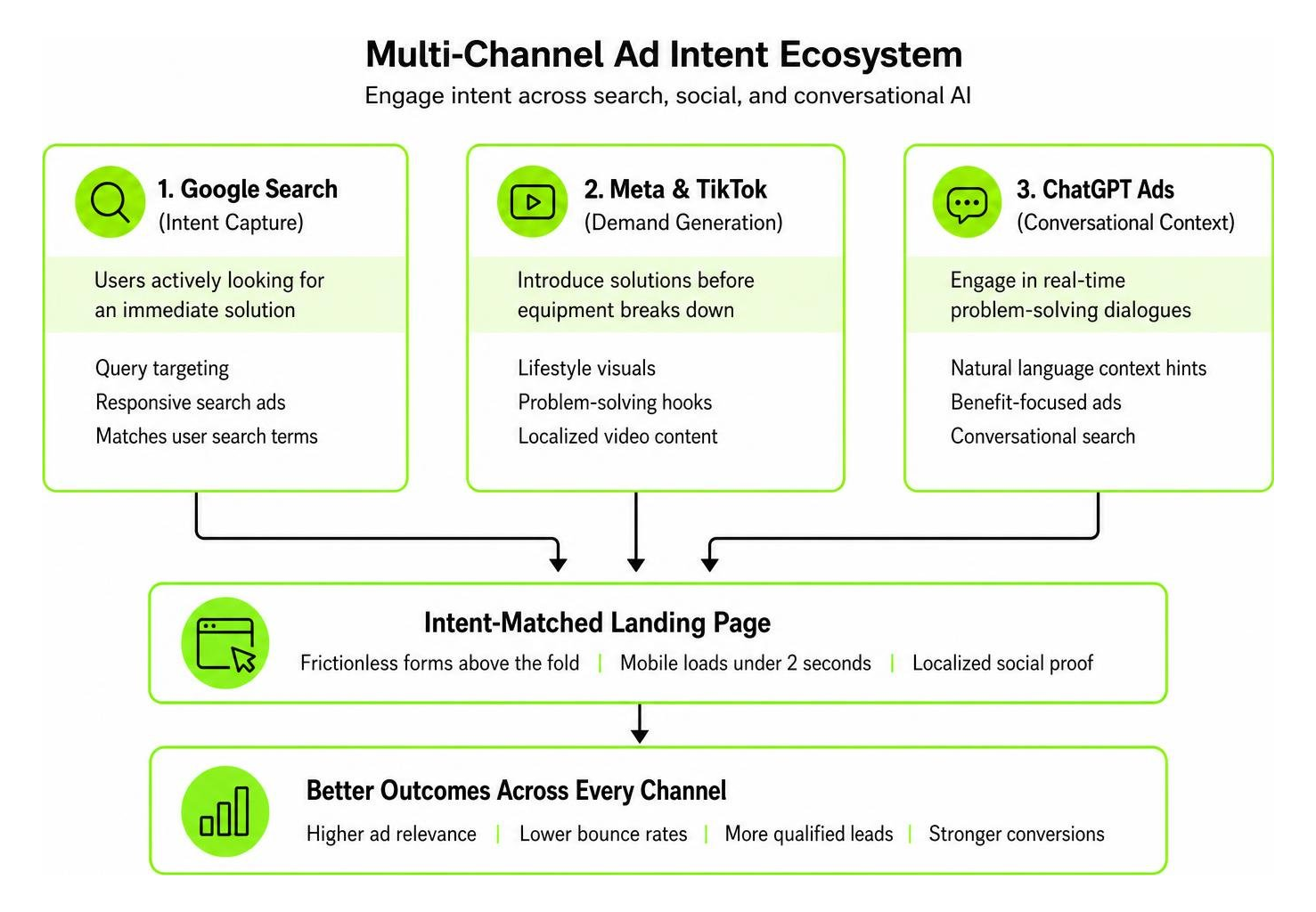
- Google Search (Intent Capture): Captures users actively looking for an immediate solution. Read our beginners guide to search ads to master query targeting and responsive search ads that dynamically match user search terms.
- Meta & TikTok (Demand Generation): Uses lifestyle visuals, problem-solving hooks, and localized video to introduce solutions to homeowners before their equipment completely breaks down.
- ChatGPT Ads (Conversational Context): With OpenAI introducing ad placements, advertisers can engage users in real-time problem-solving dialogues. In this environment, ads rely on natural language “context hints” rather than rigid keywords. Review guidance on how to Create Ads for ChatGPT Ads | OpenAI Help Center and implement strategies from ChatGPT Ads Campaign: How to Build One That Converts (2026) | Focal to build benefit-focused ads for conversational search.
Setting Bids, Budgets, and Search Targeting
Setting competitive bids requires balancing acquisition costs with long-term customer lifetime value. On search platforms, utilizing responsive search ads combined with smart bidding (such as Target CPA or Maximize Conversions) allows Google’s auction model to evaluate thousands of contextual signals per auction.
Understanding auction economics is essential for managing Google Ads cost per click without exhausting your daily allocation by mid-morning. For emergent conversational networks like ChatGPT Ads, initial test bids typically range from $3 to $5 per click in standard home services, while competitive legal and financial sectors can see bids from $8 to $18 per click.
In local markets like Birmingham, Huntsville, and Helena, AL, layering geographic radii and negative keyword lists protects your ad spend from queries outside your service territory.
Testing, Analyzing, and Scaling Ad Campaigns
Scaling an ad account is not simply a matter of increasing the daily budget; doing so without structured testing accelerates ad fatigue and spikes acquisition costs. Sustainable scaling relies on disciplined iteration.
When scaling:
- Isolate one variable at a time: Test three different hooks with the same body copy, or test two distinct avatars reading an identical winning script.
- Enforce kill rules: If an ad variant spends 1.5× your target Cost Per Acquisition (CPA) without delivering a lead, pause it immediately.
- Scale horizontally first: Duplicate winning angles into broader geographic targets or adjacent service categories before increasing individual campaign budgets by more than 20% every 48 hours.
Structured Creative A/B Testing
To find scalable winners, implement structured split-testing frameworks. Our guide to A/B testing on Facebook ads highlights how segmenting creative tests into dedicated sandboxes keeps baseline performance stable while testing new concepts.
Begin testing with a 3×3 matrix:
- 3 Hook Variations (Problem Call-Out vs. Contrarian Claim vs. Curiosity Gap)
- 1 Core Value Proposition Script
- 3 Visual Assets (AI Avatar A vs. AI Avatar B vs. Job-site B-Roll)
This structure produces distinct creative permutations, allowing you to identify whether your audience responds better to specific messaging angles or visual presentations.
Interpreting Performance Metrics in the First 14 Days
During the initial 14 days of launching a campaign, avoid making frequent changes that reset algorithmic learning. Tracking the right indicators in sequence prevents premature optimizations while protecting your ad budget.
Refer to our complete breakdown of tracking Facebook ad metrics to evaluate these critical signals:
- Days 1 to 3 (Delivery & Click Viability): Monitor Outbound Click-Through Rate (CTR) and Cost Per Click (CPC). An outbound CTR below 1.0% on social video indicates your opening hook failed to stop the scroll.
- Days 4 to 7 (Engagement & Landing Page Health): Examine landing page conversion rates. If CTR is high but conversion rate is below 5%, there is a disconnect between your ad creative and your landing page experience.
- Days 8 to 14 (Unit Economics & CPA): Measure your Cost Per Lead (CPL) and Cost Per Acquisition (CPA). Consolidate budget into the top-performing 20% of ad variants and pause the rest.
Frequently Asked Questions About Making Ads
What is the ideal budget for testing a new ad campaign?
For most local home services and regional businesses, an initial testing budget of $100 to $300 per day per platform across a 14-day window provides sufficient conversion volume to exit algorithm learning phases. Daily budgets below $30 to $50 per ad group often extend the learning phase, delaying statistical significance.
Do I need to disclose AI-generated actors in video ads?
Yes. Major advertising platforms—including Meta, TikTok, Google, and YouTube—require advertisers to disclose photorealistic synthetic media or AI-generated personas. Most ad managers offer a built-in toggle during campaign setup to ensure regulatory compliance without negatively impacting delivery.
How long should I wait before optimizing or killing an ad?
Allow new ad sets to run undisturbed for 7 to 14 days or until an individual ad spends 1.5× your target Cost Per Acquisition. Editing bids, budgets, or ad copy within the first 72 hours resets platform machine-learning algorithms, extending the learning phase.
Conclusion
Building profitable ad campaigns in 2026 requires more than just eye-catching graphics—it demands a cohesive strategy connecting audience research, dynamic video hooks, multi-channel distribution, and tightly aligned landing pages. By testing structured variations systematically and letting performance data guide your budget allocation, you can scale client acquisition predictably.
At Fusion One Marketing, our all-in-one Digital Domination program integrates custom SEO, high-converting web design, social media, and multi-channel paid advertising to help home-service businesses and regional brands in Birmingham, Huntsville, Helena, and throughout Alabama dominate their local markets.
Ready to transform your paid advertising into a predictable lead-generation engine? Explore our comprehensive guide on how to make an ad step by step and partner with our team to scale your business today.