

Cost Per Click: What You Pay for Each Ad Visit
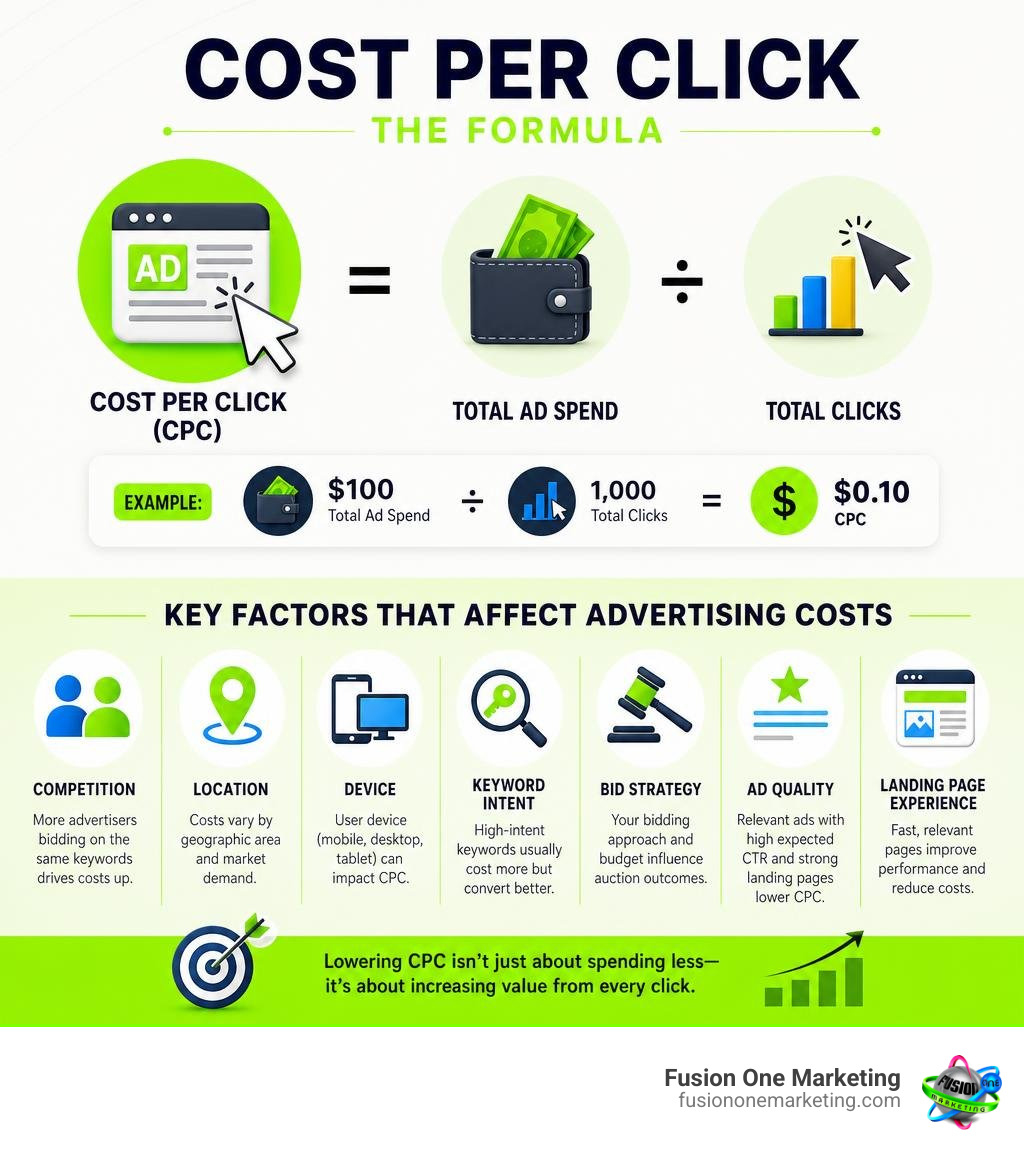
Cost Per Click (CPC) is the average amount you pay when someone clicks your online ad. Calculate it by dividing total ad spend by total clicks. For example, if you spend $100 and receive 1,000 clicks, your CPC is $0.10.
CPC matters because it shows what it costs to bring a potential customer to your website or landing page. But the cheapest click is not always the best click. A $2 click from someone searching for “emergency AC repair near me” may be far more valuable than a $0.50 click from someone who is only researching options.
For home-service businesses, the goal is simple: pay a reasonable amount for qualified visitors who call, book, or request an estimate. Your final CPC can change based on competition, location, device, keyword intent, bid strategy, and ad quality. Strong ad relevance and a fast, useful landing page can often help you compete without simply raising bids.
I’m Rob Humm, an owner of Fusion One Marketing, and I have worked in digital marketing since 2011, including Local Search and Cost Per Click campaigns for businesses seeking more qualified leads. Let’s look at how CPC pricing works, what drives ad costs, and how to make every click work harder for your budget.
Understanding Cost Per Click and How Paid Ad Pricing Works
Digital advertising platforms like Google Ads and Microsoft Advertising run on real-time auctions. Whenever someone types a search query into Google, an automated auction runs behind the scenes in milliseconds. Multiple advertisers bid for the opportunity to display their ad at the top of the search engine results page (SERP).
However, search engines do not award top placement strictly to the highest bidder. If they did, low-quality ads with massive budgets would dominate search results, ruining the search experience. Instead, platforms evaluate your maximum bid alongside your ad quality to calculate an overall Ad Rank.
According to the official Cost-per-click definition, CPC is a billing method where you only pay when an interested user takes direct action by clicking on your advertisement. Unlike traditional media like billboards or radio spots where you pay for raw exposure regardless of interest, the CPC model ensures your ad budget connects directly to measurable traffic.
How to Calculate Cost Per Click
Calculating your average cost per click is straightforward. You divide the total cost of your advertising campaign by the total number of clicks generated.
The standard formula is: Average CPC = Total Ad Spend / Total Number of Clicks
For example, if an HVAC contractor spends $1,750 on a Google Ads search campaign over a month and generates 700 clicks, the average CPC comes out to $2.50 ($1,750 / 700).
To understand where CPC fits in your broader marketing budget, it helps to compare it with alternative digital ad pricing models:
| Pricing Model | Full Name | How You Are Charged | Best Use Case | Direct Intent Level |
|---|---|---|---|---|
| CPC | Cost Per Click | Per individual click on your ad | Lead generation, service bookings, e-commerce sales | High |
| CPM | Cost Per Mille | Per 1,000 ad impressions (views) | Brand awareness, video views, broad display reach | Low to Moderate |
| CPA | Cost Per Acquisition | Per completed action (form submission, call, purchase) | Conversion-focused scaling, direct response | Very High |
Maximum CPC vs. Actual Cost Charged
A common misconception among business owners new to paid search is that setting a $5.00 bid means you will pay $5.00 every time an ad gets clicked. In reality, what you set in your account is your Maximum CPC (Max CPC)—the absolute ceiling you are willing to spend for a single click.
What you actually get billed is your Actual CPC. As explained in Google’s guide on Actual cost-per-click calculations, the Google Ads auction operates on a modified second-price auction system. You only pay the minimum amount necessary to clear the Ad Rank threshold and beat the Ad Rank of the competitor immediately below you.
If your ad has superior relevance and a higher Quality Score than a competitor, you can easily pay significantly less per click than your maximum bid while still holding the top position on the page. In scenarios where you are the only advertiser entering the auction, you may only pay the platform’s reserve price—often just $0.01 above the floor threshold.
Core Factors Influencing Your Ad Auction Costs
Your final ad costs depend on a dynamic mix of market forces, technical relevance, and targeting parameters. In local markets across Alabama—whether running campaigns in Birmingham, Huntsville, or Helena—these variables determine how far your budget stretches.

- Industry Competition: High-ticket services with high customer lifetime values (such as emergency plumbing, HVAC replacement, and legal services) see fierce competition, naturally driving up keyword auction bids.
- Geographic Targeting: Bids fluctuate depending on population density and local market competition. Running ads across an entire metro area like Birmingham may carry a different average cost than hyper-local radius targeting in Helena.
- Device Segmentation: Mobile devices often produce higher conversion volume for emergency home services due to “click-to-call” functionality. Depending on user behavior, mobile CPCs can vary compared to desktop traffic.
- Dayparting (Ad Scheduling): Clicks during peak service hours (such as standard business hours or extreme weather events) can see higher auction density than late-night traffic.
The Role of Google Ads Quality Score
Quality Score is Google’s diagnostic tool that rates the quality and relevance of your ads compared to other advertisers. Measured on a scale of 1 to 10 for each keyword, it serves as a direct multiplier in the Ad Rank equation. A high Quality Score acts like a discount coupon on your bids, while a low score imposes a financial penalty.
Quality Score consists of three core components:
- Expected Click-Through Rate (eCTR): Google’s estimation of how likely users are to click your ad when shown for that keyword.
- Ad Relevance: How closely your ad copy matches the specific intent behind the user’s search query.
- Landing Page Experience: How relevant, transparent, mobile-friendly, and fast your destination page is for the visitor.
By organizing campaigns into tightly themed ad groups and matching your ad text directly to dedicated landing pages, you can raise Quality Scores, boost ad positions, and substantially lower your actual cost per click.
Manual vs. Automated Bidding Strategies
Choosing the right bidding strategy determines how actively you manage your ad spend day-to-day. As outlined in the documentation About Manual CPC bidding, manual bidding allows advertisers to establish custom maximum CPC limits at the keyword or ad group level.
Manual bidding provides total budget control, ensuring you never exceed your pre-set limits. It is ideal for new campaigns with little historical data or niche local markets where budget predictability is critical.
In contrast, automated bidding strategies (such as Target CPA, Target ROAS, or Maximize Conversions) use machine learning to evaluate thousands of auction-time contextual signals—such as user device, operating system, location, and time of day—to adjust bids dynamically in real time.
Automated bidding works well once a campaign has generated steady conversion volume (typically 30+ conversions per month), allowing algorithms to find valuable leads within your target efficiency goals.
Proven Strategies to Lower Ad Spend and Mitigate Fraud
Keeping ad spend profitable requires continuous optimization. If you launch a campaign and leave it on autopilot, broad match expansion, irrelevant queries, and invalid traffic will quickly eat away at your return on investment.

Actionable Optimization Tactics to Reduce Cost Per Click
To trim excess ad spend while driving qualified leads, implement these proven tactics:
- Build Comprehensive Negative Keyword Lists: Regularly review your Search Terms report to identify irrelevant queries triggering your ads. If you are a residential plumbing contractor, adding negative keywords like “commercial,” “jobs,” “salary,” or “DIY” prevents paying for useless clicks.
- Target Long-Tail Keywords: Broad keywords like “plumber” carry high CPCs and mixed intent. Specific long-tail phrases like “tankless water heater repair near me” feature lower competition, cheaper clicks, and significantly higher conversion intent.
- Improve Ad Assets (Extensions): Utilize call assets, sitelink assets, callout snippets, and structured snippets. These increase your ad’s visual footprint on the search results page and improve expected CTR without increasing your bid.
- Refine Keyword Match Types: Avoid relying purely on broad match without proper guardrails. Utilizing phrase match and exact match gives you tighter control over search term relevance.
- Optimize Landing Page Load Speed: A landing page that takes more than three seconds to load causes visitors to bounce, tanks your Landing Page Experience score, and increases your CPC over time.
Essential Campaign Performance Metrics to Monitor
Managing a paid search campaign effectively requires looking beyond CPC in isolation. A low cost per click means very little if none of those visitors turn into paying customers.
Track these core metrics together for a complete performance picture:
- Click-Through Rate (CTR): The percentage of impressions that result in a click. Higher CTR signals strong ad relevance.
- Conversion Rate (CVR): The percentage of visitors who complete a desired action, such as filling out a quote form or placing a phone call.
- Cost Per Acquisition (CPA): Total ad spend divided by total conversions. This tells you the actual cost to acquire a lead.
- Return on Ad Spend (ROAS): Total revenue generated divided by total ad spend, measuring direct profitability.
- Impression Share: The percentage of total available auctions your ad actually appeared in, showing market reach and potential headroom.
Frequently Asked Questions About CPC Advertising
What is the difference between CPC and CPM?
CPC charges you only when a user actively clicks on your advertisement, making it a direct-response model focused on traffic and conversions. CPM (Cost Per Mille) charges you a fixed rate for every 1,000 times your ad is displayed on a screen, regardless of whether anyone interacts with it. CPM is best suited for visual brand awareness and video campaigns, while CPC is superior for generating immediate leads and sales.
What is a good average cost per click in 2026?
There is no single universal “good” CPC, as averages vary widely by industry, geography, and commercial intent. An average CPC of $2.50 to $5.00 is typical across many home services, while specialized emergency repairs or competitive legal terms can exceed $20 to $50 per click. A good CPC is simply one that comfortably aligns with your conversion rates and customer profit margins to achieve a profitable Cost Per Acquisition.
How does click fraud impact overall ad spend?
Click fraud occurs when malicious competitors, automated bot networks, or click farms repeatedly click on your paid ads with no intention of buying, draining your daily budget. Major ad networks use automated filtering systems to detect and credit back invalid clicks automatically. However, third-party fraud detection software and proactive IP exclusions provide an extra layer of protection to safeguard your ad spend from budget waste.
Conclusion: Maximizing ROI with Smart Ad Management
Managing paid search campaigns requires striking the right balance between bid management, technical relevance, keyword selection, and post-click landing page optimization. When done right, paid advertising is not an expense—it is a predictable, scalable revenue engine for your business.
At Fusion One Marketing, our all-in-one “Digital Domination” program combines high-performance PPC management with local SEO, custom web design, and social media marketing to deliver measurable business growth. If you are ready to eliminate wasted ad spend and generate high-intent service calls across Birmingham, Huntsville, and Helena, let our team optimize your cost per click campaigns for maximum return on investment.