

How Amazon Ads CPC Works and Why It Matters
Amazon Ads CPC is the average amount you pay when a shopper clicks an ad. Most Sponsored Products clicks in 2026 cost about $0.80 to $1.30, but your actual cost depends on the keyword, competition, placement, bid, and how likely your product is to convert.
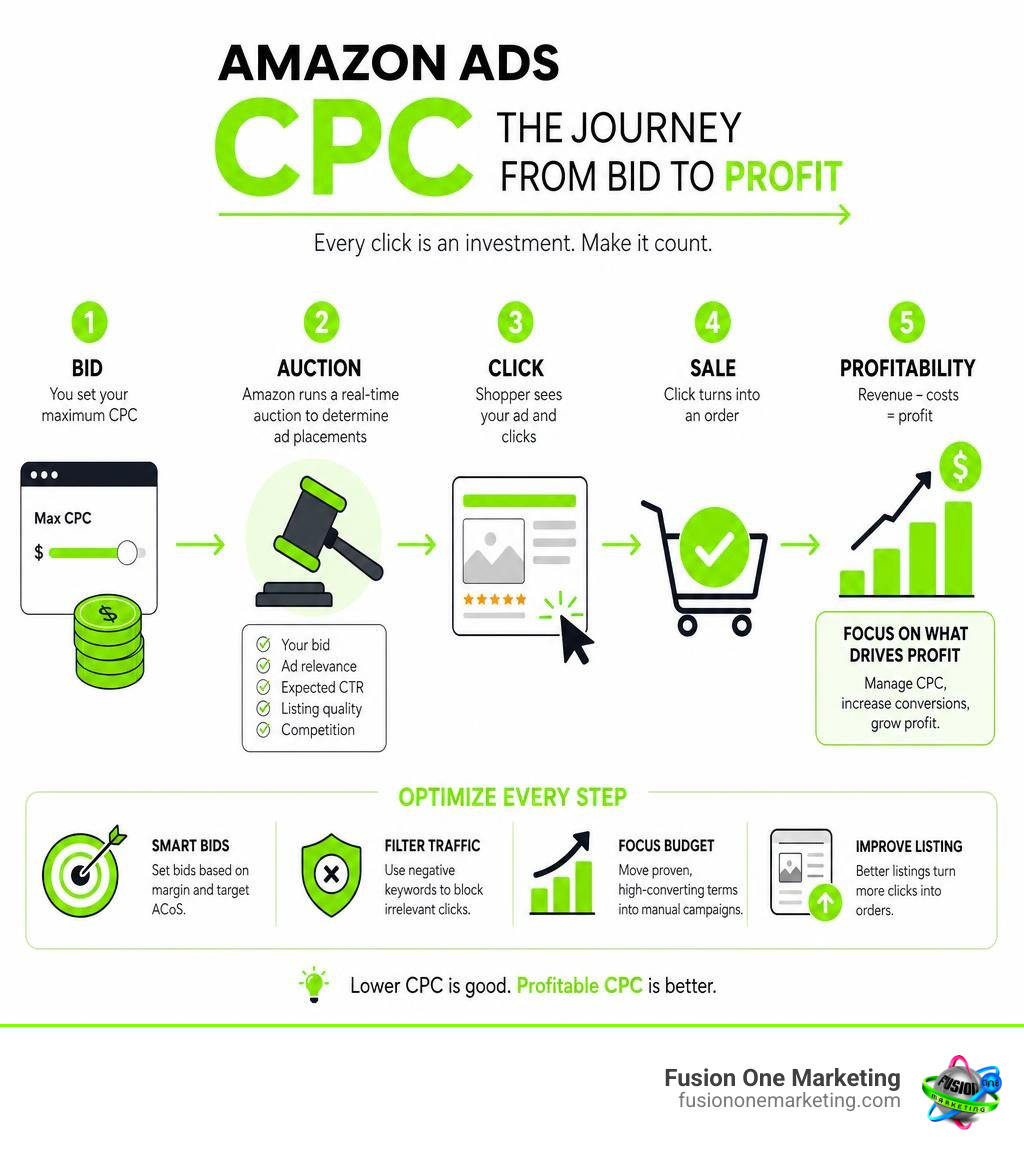
To win the bidding game, do not simply chase the cheapest clicks. Instead:
- Set bids based on your product margin and target ACoS.
- Use search-term data to block irrelevant clicks with negative keywords.
- Move proven, high-converting terms into tightly controlled manual campaigns.
- Improve the listing so more paid clicks become orders.
Amazon runs a real-time auction for ad placements. Your maximum bid matters, but it is not the whole story. High-demand categories, Prime Day, Black Friday, and premium placements such as Top of Search can raise CPC quickly. A higher-cost click can still be the better investment when it leads to more profitable sales.
I am Rob Humm, co-owner of Fusion One Marketing, and I have worked in PPC and digital marketing since 2011. I help business owners understand where their marketing dollars go, including how to manage Amazon Ads CPC with clearer data and smarter decisions.
2026 Benchmarks: Decoding the True Costs of Amazon Ads CPC
Navigating the Amazon advertising landscape requires understanding realistic cost baselines across different ad formats and market sectors. Across the entire platform, the overall average cost-per-click stands at $1.22 in 2026. This reflects a steady climb from pre-2020 averages of around $0.71, driven by heightened merchant participation and tighter auction competition.
To build an efficient budget, advertisers must understand the basics of pay-per-click advertising and study how unit costs differ across ad formats:
| Amazon Ad Format | Average 2026 CPC Range | Primary Strategic Focus |
|---|---|---|
| Sponsored Products | $0.80 – $1.30 | Direct conversion on search results & detail pages |
| Sponsored Brands | $1.10 – $2.50 | Brand awareness, headline banners, & video assets |
| Sponsored Display | $0.80 – $1.60 (or $4–$12 CPM) | Retargeting, category cross-selling, & conquesting |
Category competition causes substantial variances in these figures. Highly contested sectors like Beauty & Personal Care regularly reach Sponsored Brands CPCs of $2.30 or higher, and competitive niches such as Electronics and Home Improvement average roughly $1.50 per click. Conversely, lower-friction sectors such as Home Decor command more moderate Sponsored Brands rates around $1.20, and broader Health & Personal Care targets sit near an average of $0.85 per click.
Advertisers wanting to study Amazon’s baseline rules can consult the official Amazon CPC guide to understand how basic auction rules interact with daily campaign controls.
Comparing Pricing Models: CPC vs CPM vs vCPM
Not every placement on Amazon bills on a standard cost-per-click model. Selecting the right pricing model ensures ad spend aligns with business goals:
- Cost-Per-Click (CPC): The foundational model for Sponsored Products overview ads and standard manual keyword campaigns. You pay strictly when an interested shopper clicks through to your listing. This makes CPC ideal for driving direct response and measurable conversions.
- Cost-Per-Mille (CPM): Available primarily within Sponsored Display and the Amazon Demand-Side Platform (DSP), charging a fixed rate per 1,000 raw ad impressions (ranging typically between $4 and $12).
- Viewable CPM (vCPM): Billed per 1,000 viewable impressions, counting only when at least 50% of the ad creative appears in the shopper’s viewport for one continuous second or longer.
CPC remains the most reliable mechanism for bottom-of-funnel sales. Impression-based models (CPM and vCPM) work best for top-of-funnel defensive branding and retargeting campaigns off-Amazon.
How the Amazon Ads CPC Auction System Calculates Actual Cost
Amazon uses a second-price auction mechanism. In this model, the winning bidder does not pay their maximum bid. Instead, the winning advertiser pays just $0.01 above the second-highest bid, adjusted by real-time relevance factors.
Three core components dictate your final charged CPC:
- Maximum Bid: The maximum dollar amount you authorize Amazon to spend on a keyword click.
- Ad Relevance & Listing Conversion Rate: Amazon favors listings that turn clicks into purchases. A high conversion rate provides algorithmic favorability, lowering the actual CPC required to secure a placement.
- Placement Bid Adjustments: Modifiers applied within Amazon Campaign Manager (ranging up to +900%) for premium positions such as Top of Search (First Page) and Product Detail Pages.
Premium placements on Top of Search generate roughly twice the click-through rate of lower positions. While placement modifiers increase your base bid, the resulting jump in conversion intent often offsets the higher unit cost.
Measuring True Advertising Profitability: ACoS, ROAS, and TACoS
Evaluating ad spend requires analyzing unit economics alongside click volume. Relying strictly on raw spend masks whether an account is gaining market share or burning margin.
Applying an accurate cost per click formula helps clarify ad efficiency across three critical metrics:
- ACoS (Advertising Cost of Sale): Expressed as
(Ad Spend / Ad Revenue) * 100. This tracks direct campaign performance. The 2026 platform-wide median ACoS hovers around 29.6% to 29.8%. - ROAS (Return on Ad Spend): The mathematical inverse of ACoS
(Ad Revenue / Ad Spend). A 25% ACoS translates to a 4.0 ROAS. - TACoS (Total Advertising Cost of Sale): Calculated as
(Total Ad Spend / Total Business Revenue) * 100. TACoS measures advertising impact on total revenue (including organic sales).
While ACoS monitors single-campaign health, TACoS reveals whether paid ads are driving organic search ranking improvements and sustainable growth.
Calculating Break-Even and Target ACoS for Sustainable Growth
A campaign is profitable only when ad spending remains below the product’s profit margin before advertising expenses.
If a widget sells for $50 and total landed product costs plus Amazon referral and fulfillment fees equal $35, your pre-ad profit is $15 ($15 / $50 = 30% margin). Your Break-Even ACoS is 30%.
To generate a net 10% profit margin on advertising sales, establish a Target ACoS (tACoS) of 20% (30% Break-Even Margin minus 10% Target Profit).
During product launches, sellers frequently run at or near break-even ACoS (30%) to generate sales velocity and review momentum. Once organic rank stabilizes, lowering bids brings ACoS down toward target efficiency.
Scaling Budgets by Business Size: From New Sellers to Enterprise
Budget pacing should scale alongside account maturity and SKU depth:
- New Sellers / Product Launches: Allocate $500 to $1,000 per month ($15 to $35/day). Focus on gathering search query data and building conversion history without overspending.
- Mid-Level Sellers: Allocate $2,000 to $10,000 per month. Split funds across manual exact keywords, product category defense, and Sponsored Brands video campaigns to grow market share.
- Enterprise Brands: Budgets exceed $20,000+ monthly, utilizing custom portfolio budget caps, automated bid dayparting, and programmatic Amazon DSP audiences.
Using campaign portfolios prevents unconstrained spending while ensuring top-performing ASINs maintain full visibility during high-traffic daytime hours.
Strategic Bidding and Campaign Optimization Techniques
Sustainable Amazon advertising requires structuring campaigns to prevent search terms from competing against each other.
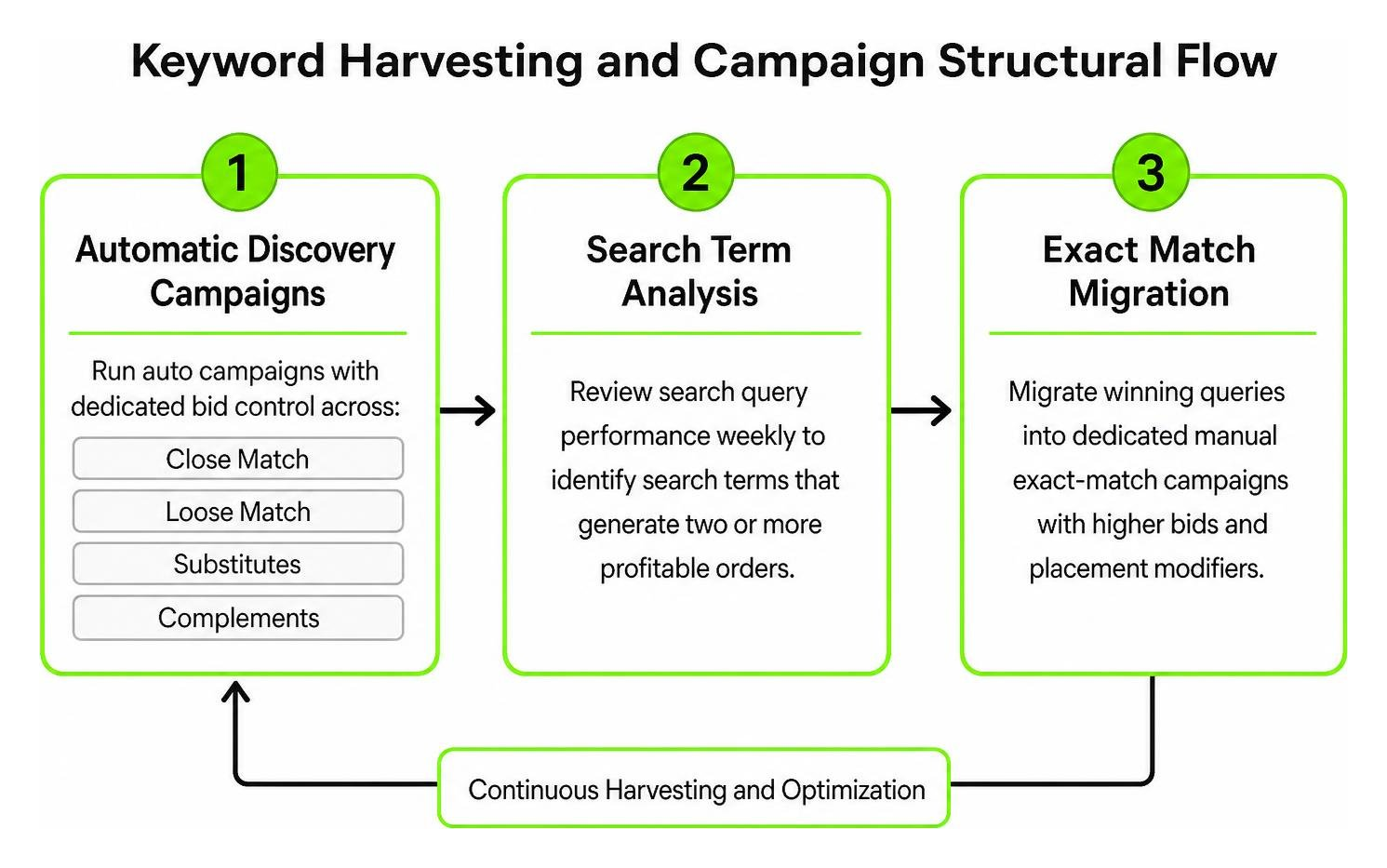
A high-performing campaign architecture relies on systematic keyword harvesting:
- Automatic Discovery Campaigns: Run auto campaigns with dedicated bid control across Close Match, Loose Match, Substitutes, and Complements.
- Search Term Analysis: Review search query performance weekly to identify search terms that generate two or more profitable orders.
- Exact Match Migration: Migrate winning queries into dedicated manual exact-match campaigns with higher bids and placement modifiers.
- Negative Match Isolation: Add harvested keywords as negative exact matches in the auto campaign to prevent internal bidding wars.
Applying smart ways to reduce PPC spending and boost ROI helps eliminate unneeded impressions and keeps budgets focused on high-converting search intent.
Proven Strategies to Lower Amazon Ads CPC Without Sacrificing Sales
Advertisers can reduce unit click costs while sustaining overall sales volume through four proven practices:
- Aggressive Negative Keyword Management: Adding negative phrase and negative exact terms cuts out low-converting shopper traffic. Regular negative keyword maintenance can reduce wasted ad spend by up to 30% in competitive product categories.
- Long-Tail Keyword Targeting: Shifting focus from broad head terms (such as “headphones”) to specific long-tail queries (such as “noise cancelling over ear bluetooth headphones for travel”) drops average CPC while delivering higher purchase intent.
- Listing Optimization and A+ Content: High-resolution product imagery, structured bullet points, and enhanced brand content lift purchase likelihood by 5% to 10%. Higher conversion rates lower the effective cost required to win ad placements.
- Weekly Audit Cadence: Sellers who conduct weekly campaign reviews achieve an average 15% improvement in advertising efficiency compared to accounts reviewed monthly.
Navigating Seasonal CPC Spikes During Prime Day and Q4 Holidays
Seasonal shopping events drastically alter marketplace dynamics. During events like Prime Day (typically yielding the highest seasonal CPCs, averaging around $1.27) and Q4 holiday peaks, unit CPCs frequently climb 20% to 40% as national brands increase their bids.
To manage seasonal cost spikes without depleting capital:
- Increase Budgets, Not Just Bids: Raise daily budget caps by 50% to 100% two weeks ahead of the event to capture early browsing traffic without over-inflating base keyword bids.
- Defend Branded Search Queries: Protect your brand name keywords with exact-match bids to prevent competitors from stealing high-intent shoppers directly from your product pages.
- Normalize Post-Event Settings: Following peak retail dates, lower bids and reduce placement modifiers within 24 to 48 hours to prevent post-holiday margin loss.
Frequently Asked Questions About Amazon Ads CPC
Why is my Amazon CPC higher than the category average?
CPCs climb above category benchmarks primarily due to:
- Aggressive placement modifiers applied to Top of Search placements (+200% to +900%).
- Broad match types bidding against expensive, unrelated search terms.
- Below-average listing conversion rates, which require higher monetary bids to compete against stronger ASINs.
Is a lower CPC always better for Amazon ad profitability?
No. A low CPC often targets low-intent, generic search terms that yield poor conversion rates. Paying $1.50 for a click that converts at 20% produces an ad cost per acquisition of $7.50. Conversely, paying $0.50 for a low-intent click that converts at only 3% requires $16.67 to make a sale. Focus on conversion value and target ACoS rather than lowest click cost alone.
When should sellers transition from automatic to manual CPC bidding?
Sellers should run both simultaneously from the launch phase. An automatic campaign functions as an ongoing search-term discovery tool. Once an automatic campaign generates 14 to 30 days of data, convert all search terms with proven conversions into manual exact-match campaigns, negating them from the automatic source to ensure complete bid control.
Conclusion
Managing Amazon advertising efficiently requires balancing aggressive discovery with strict cost controls. Long-term profitability comes from pairing clean campaign architecture with active negative keyword pruning and high-converting listing pages.
Tracking contribution margins, setting clear target ACoS thresholds, and adjusting bids based on placement performance protects margins against rising category competition. If you want to turn digital ad spend into predictable revenue, explore our strategic guidance on mastering your cost per click to scale your business with confidence.